

Blog
The Politics of Representation: What Mamdani’s Victory Means for Muslims in America and Beyond | Blog
In a heady fervor that is reminiscent of Obama’s electoral triumph in 2008, it seems that for Muslims, “our time has come.” Or has it?
Authored by
Published: December 1, 2025 •Jumada al-Thani 10, 1447
Updated: December 2, 2025 •Jumada al-Thani 11, 1447
Read time: 10 min
On this page
As the right-wing tabloid NY Post would have you believe, the Green-Red Alliance has succeeded in infiltrating US politics and is poised to impose Sharia Socialism on the hapless people of New York City, with Zohran Mamdani as the Communist Caliph in Chief. Others are hailing Mamdani’s victory as a fundamental shift in US politics, even a fulfillment of Malcolm X’s legacy. In a heady fervor that is reminiscent of Obama’s electoral triumph in 2008, it seems that for Muslims, “our time has come.” Or has it? Below is a rumination on what Mamdani’s victory means and doesn’t mean.
1. Nothing will ever be the same
Remember, if you can, the prospect of Palestinian liberation on October 6th, 2023. As Israel “mowed the lawn” in Gaza at regular intervals, the euphemistically named “peace process”—which Edward Said rightly labeled an instrument of surrender—ensured the slow but inevitable annexation of the West Bank. The right to return having essentially been abandoned by the Oslo Accords, Israel pursued a strategy of slow-drip genocide and ethnic cleansing as it simultaneously built soft power through political, economic, and cultural normalization. Every time you saw an Israeli contestant in Eurovision or Maccabi Haifa in the Champions League you could almost forget that Israel was an apartheid state or that the Nakba ever happened. Almost.
With the Palestinian Authority eagerly serving as Israel’s enforcer—playing the role of Qarun to a tee—the final piece was Trump’s Abraham Accords, which seemed to doom Palestinian resistance and the dream of Palestinian liberation not to a spectacular defeat, but to irrelevance. The well-heeled Arab client states and their dictators played their part, ready to negotiate with the occupier behind the backs of Palestinians, at least as much as they thought their subjects would tolerate. Even Norman Finkelstein gave up.
Two years later, support for Israel is the wedge issue reconfiguring both the political left and right in the United States. Zionist propaganda suddenly doesn’t seem to work despite the inordinate amount of money dumped into it, the strings of normalization are being cut one at a time, and Arab dictators, under renewed pressure, are hesitating and hedging. To complete the sense of whiplash, none other than Laura Loomer is calling to end aid to Israel, in her own patently deranged way.
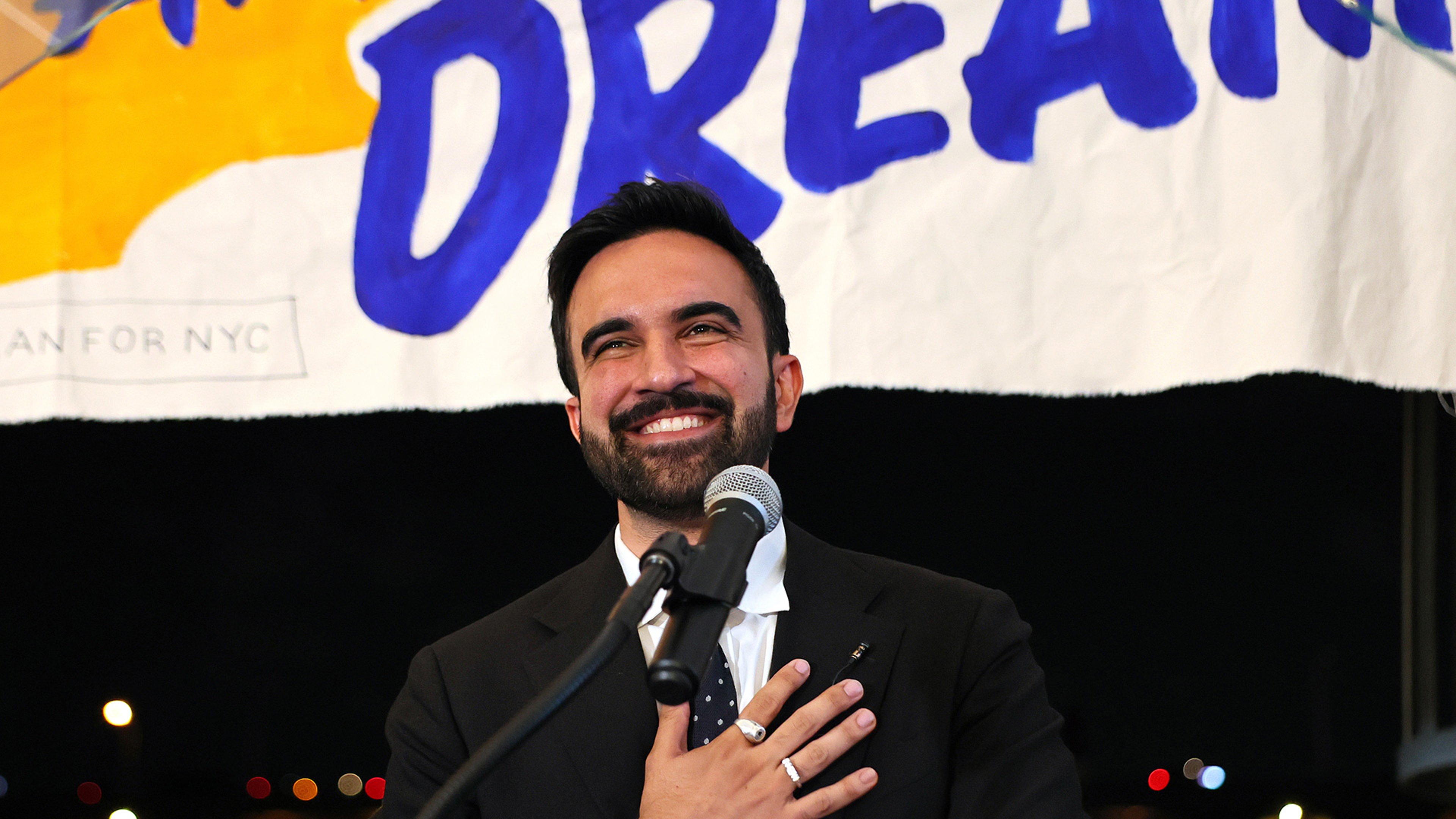
On top of all this, the energy generated against Israel’s actions over the last two years shook New York City’s political machinery—infamous for its support of Israel—to the core. Mamdani’s march to victory rode this wave, enabled by his electrifying charisma, his uncanny ability to connect with local immigrant communities, and his contagious message of hope. Whether Mamdani intended it or not, whether he is a willing participant or not, his election is a small part of the ongoing ummatic struggle for dignity and self-determination which has been carried forward for generations by courageous and faithful scholars, leaders, and the people of Palestine. Things are moving fast; it seems like history is being made every month. The dominoes keep falling one after another. We are still living in the wave generated by the strength and resilience of Gaza, and no one knows exactly how high the water will rise.




2. Zionism lost, mostly
Mamdani’s victory both symbolizes and accelerates the fallout for Zionism and the collapse of US support of the Jewish-supremacist state occupying Palestine.
Zionist billionaire Bill Ackman pledged back in June to throw his fortune behind anyone who could defeat Mamdani, inviting other members of the 1% to join him. He fulfilled his promise and then some. All told, over $40 million was spent in an attempt to steal the New York mayoral election from the person who would ultimately prevail as the people’s choice.
It wasn’t just moneyed interests that were involved in the conspiracy; it was specifically the Zionist contingent, which blew every dogwhistle and rang every alarm bell it could find to signal that Mamdani’s victory would pose an existential threat to Israel and even Jews themselves.
All that money and effort has gone up in smoke. Perhaps worse for the Zionist movement is the fact that the extremely public and unhinged manner in which they conducted themselves during the election deepened Americans’ suspicion that Israel and Zionists do have too much influence and control over US politics, despite their resolute attempts to dismiss this naked fact as an antisemitic conspiracy.
All this means that Zionism continues to hemorrhage credibility and cannot be taken seriously anymore as the putatively innocuous desire for Jewish “self-determination” in their “traditional homeland.” Zionism has exposed itself throughout this election, throughout the Gaza Holocaust, and indeed throughout its entire lifespan as a psychotic, supremacist, genocidal movement that holds nothing sacred but itself and follows no rules but its own.
The absolute drubbing that Mamdani’s opponents received on election day means that Zionism’s influence and thus support is seriously vulnerable, another fact that Zionists are loath to admit but increasingly forced to in an attempt to rally its stalwarts. Politicians—being transactional, opportunist creatures by default—could potentially abandon Israel entirely if association with the Zionist lobby continues to trend negative, a reality that even the disgraced Alan Dershowitz recently admitted.
Zionism is a sinking ship, but is the collapse inevitable? Not so fast; there were other elections that took place on November 4th, and Zionism did not resoundingly lose from coast to coast. The anti-Zionist Omar Fateh lost his bid for mayor of Minneapolis, much to the relief of Zionists. The victories of centrist Democrats Mikie Sherrill (NJ) and Abigail Spanberger (VA) are no cause for great celebration; both women appear cautious and calculated on Palestine, earning them failing grades from pro-Palestinian groups like AJP Action as well as criticism from Zionist groups. In other words, the cracks are showing but the dam hasn’t broken yet.
This sets up a showdown of enormous significance in the coming 2026 midterm primaries. Opposing Zionist candidates with pro-Palestinian ones will be a top priority for Muslims, and the results will either pull the plug on Zionist influence or else give it a lifeline.
3. Substance over symbol (insha'Allah)
The next major takeaway from the NYC mayoral race was the resonance of Mamdani’s laser-focus on tangible issues such as affordability despite his opponents’ best efforts to shift to more symbolic terrain. While Cuomo, Adams, and Sliwa relied on vilifying Mamdani alternatively as ISIS’s or Stalin’s preferred candidate, Mamdani discussed rent freezes, expanding public transportation, and food security. “There isn’t a moment where we didn’t notice the Islamophobia,” Zara Rahim, a senior adviser on Mamdani’s campaign, told The New Yorker’s Rozina Ali. “But we have extensive message disciplining. We will talk about affordability until your ears bleed.”
When it was clear that no one could beat Mamdani outright, his opponents resorted to sabotage, planting misinformation about his position on prostitution, even assuming the role of mufti by calling it haram in an attempt to keep Muslim voters home.
However, the politics of fear and cynicism were obliterated by simply having a vision—even if flawed and deeply contested—as well as speaking to almost universal pain points that New Yorkers from virtually every background feel. Mamdani’s opponents never really offered an alternative vision, instead relying on catastrophic doomsday scenarios of what would happen if Mamdani won.
The fact that scare tactics lost out to substance is encouraging. In the heyday of legacy media, the symbolic register and fear-mongering were virtually all people were exposed to, asserting a monopoly on determining what “the issues” were and what people should care about or be scandalized by. Now, social media provides an opportunity for disrupting that monopoly by accessing audiences directly. Even with shadow-banning and algorithm manipulation, the speed of internet culture and the money to be made on virality keep the people one step ahead of the gatekeepers. This shift from legacy to social media was at play during one of the most memorable moments of the campaign, when Mamdani refused to say he would visit Israel or even answer which nation he would visit first as the new mayor, instead stressing his intent to stay local and focus on New Yorkers. In previous eras the affected indignation of the debate moderators would be echoed in the traditional mass media, who would dutifully return to the narrative over and over, signaling to the audience that a scandal was afoot. In today’s more democratized media landscape, the disingenuous nature of the question and the questioner was highlighted all across social media, aligning people even further with the anti-establishment dimensions of Mamdani’s campaign.
The power of substance over symbol is also a poignant reminder for Muslims specifically. Muslims are on a short list of groups who have been most targeted by coordinated smear campaigns and propaganda. Drop Site News has leaked that Israel has data to back up what we already knew anecdotally—that tying Islam and Muslims to terrorism is the single most effective messaging to claw back sympathy for Israel… or at least terminate the political will to stand in their way. As Caitlin Johnstone has said, “Zionists push Islamophobia because it’s easier than getting people to like Israel.”
Muslims must respond by not just exposing the misinformation, which is important, but also by providing substance to their communities and society at large. That includes articulating a vision of shared flourishing that resonates with the pain points of the large swath of the population. With SNAP benefits being cut and a dysfunctional healthcare system plunging people into crippling debt, Muslims should rise to fill these gaps in solidarity and with mutual aid. At a national scale, our vision must be bipartisan or non-partisan, perhaps something combining Ian Carroll’s idea of “Team God”—a nonpartisan movement of faith-based, morality-minded people—with the growing calls for the left to abandon its misadventure into the culture wars and get back to focusing on socioeconomic issues. Of course, in addition to having and articulating a compelling vision, we have to roll up our sleeves and do the work.
4. Representation as narcotic
Finally, Muslims should note that Mamdani’s platform is firmly rooted in the progressive left, including stances on gender and sexuality that do not line up with Islamic teachings. But politics is rarely a clean match with our ideals, and communities often end up backing candidates who can at least prevent imminent harm or move the needle in their favor. Nonetheless, we should remember that Mamdani’s victory satisfies the aesthetic representation of many Muslims—which does have some value—but not the representation of universal Islamic values and principles that observant Muslims hold dear.
Muslims need to be careful not to repeat the mistakes of the Obama era, in which Obama’s aesthetic appeal laundered his surveillance apparatus and war crimes, crimes which earned him the moniker the King of Drones. Aesthetic representation loses its meaning when it is conscripted to perpetuate evil. Intersectional oppression is still oppression.
Overidentification with Mamdani will similarly lead to disappointment, disillusionment, and ultimately disempowerment. We must hold Mamdani accountable and oppose him concerning what we disagree with, not keep quiet because he is “one of our own.” Allah says, "O you who have believed, be persistently standing firm in justice, witnesses for Allah, even if it be against yourselves or parents and relatives" (Qur’an 4:135).
The goal is not to simply get more Muslims into office or positions of power. We don’t want Muslims in power who are going to normalize evil. Neither power nor representation are ends in themselves; they are means by which a vision is achieved and values are institutionalized.
For all we know, Mamdani might end up betraying the principles that generated his impressive grassroots support. According to some activists, he already has. Knowing that Mamdani is not our savior, but a metric of our community’s growing political power and organization, should take the sting out of that possibility. Regardless, this should not deprive us of a moment of joy. Allah outlines an instructive scenario in the beginning of Surah al-Rum, "The Byzantines have been defeated in the nearest land. But they, after their defeat, will be victorious within three to nine years. To Allah belongs the command before and after. And that day the believers will rejoice" (Qur’an 30:2–4).
The Byzantines were no friend to the Muslims… in fact, the two sides engaged in periodic warfare over the course of four centuries. But at the particular time in which the above verses were revealed, Persia was the bigger and more immediate threat. While the enemy of our enemy might not be our friend, we are allowed to celebrate their victory and what it means for the advancement of our own cause.
Perhaps Mamdani will divest New York City from Israel and arrest Netanyahu at JFK international airport, perhaps he won’t. Either way, Muslims must keep it moving. The ongoing ummatic struggle—grounded in steadfastness, principled resistance, and justice—this is what should define the moral narrative we align ourselves with. And unlike the supremacist logic of Zionism, our struggle and our vision is not predicated upon the eradication or subjugation of others; rather, it is based on divinely-bestowed values that facilitate the true flourishing of all.



Tom Facchine
Research Director of Islam and Society
Disclaimer: The views, opinions, findings, and conclusions expressed in these papers and articles are strictly those of the authors. Furthermore, Yaqeen does not endorse any of the personal views of the authors on any platform. Our team is diverse on all fronts, allowing for constant, enriching dialogue that helps us produce high-quality research.
Want to appear on Yaqeen?