fbpixel
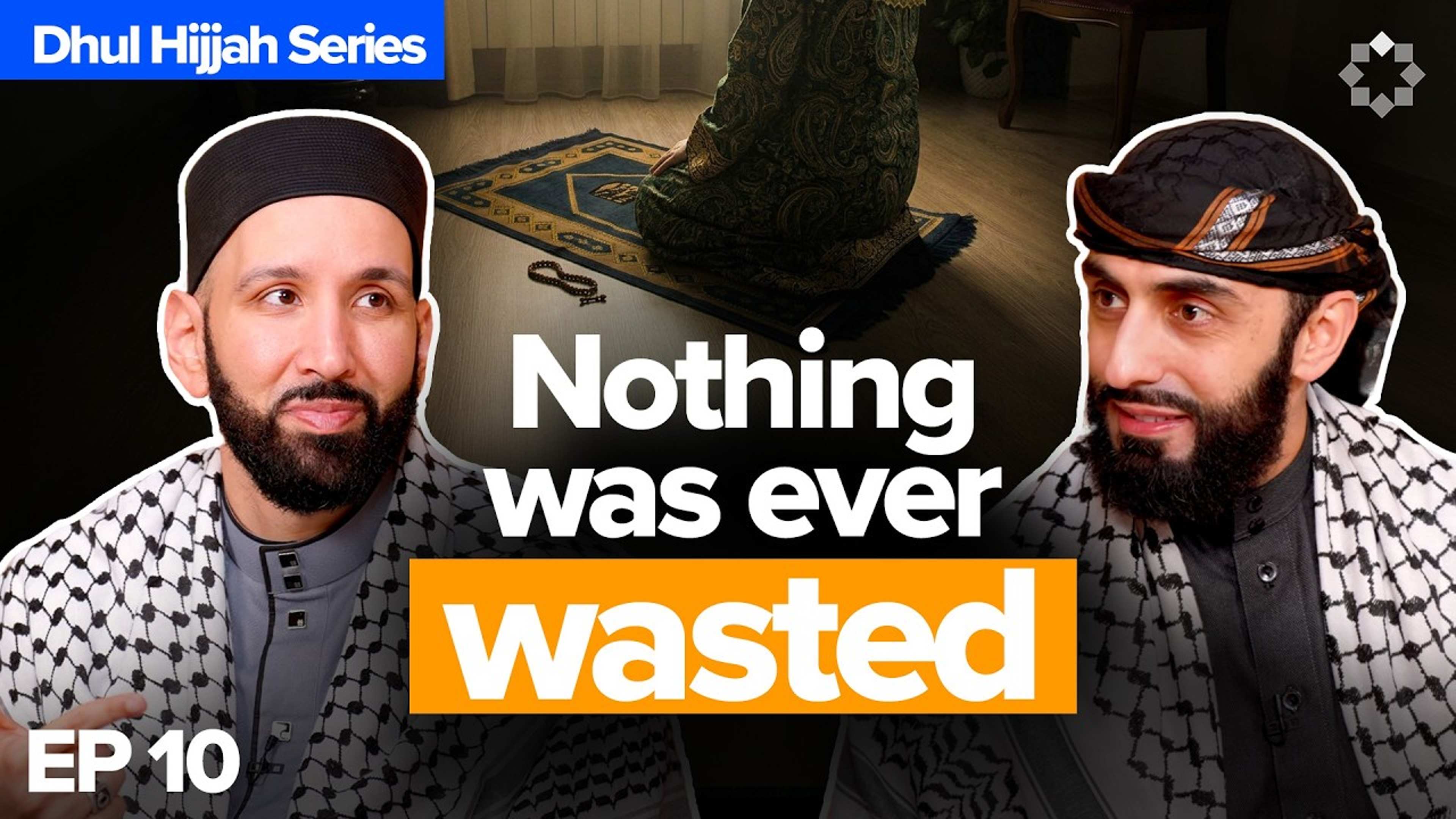
Ep.10 | He Will Give You What You Hope For | Dhul Hijjah | Dr. Omar Suleiman & Sh. Ali Hammuda

The Book of Heart Softeners Dhul Hijjah 2026

Ep.10 | He Will Give You What You Hope For | Dhul Hijjah | Dr. Omar Suleiman & Sh. Ali Hammuda

Love is proven by sacrifice. In the final episode of The Book of Heart Softeners, we reflect on what it truly means to prefer Allah over the comforts, desires, and distractions of this world. Whether it’s leaving the warmth of your bed for prayer, giving away wealth, seeking sacred knowledge, or resisting your desires, every sincere sacrifice is seen by Allah—and never goes unrewarded.

Join Sh. Omar Suleiman and Sh. Ali Hammuda for a powerful conclusion to the series on what it means to live for Allah sincerely and to trust that He will give you everything you hoped for and more. Special thanks to Heenat Salma Farm for hosting and supporting this series, and to Caravane Earth for collaborating with us on this journey.

This transcript was auto-generated using AI and may contain misspellings.
00:00Who Are You Sacrificing For?
00:30In summary, my brothers, moving on from here, my encouragement to you, my encouragement to our viewers as well, is to create a connection with wahy.
00:59From the noise and the clamor of life, to retreat from time to time and expose yourself to revelation. Not just in terms of study, and that is essential, but also in being in the gathering where Qur'an is recited.
01:20As-salamu alaykum wa rahmatullahi wa barakatuh. First and foremost, we say Eid Mubarak to all of you who will be celebrating today. May Allah subhanahu wa ta'ala bless you and accept from you and bring you close to Him. Allahumma ameen.
01:32And for all of you, as we've taken this journey together through nine hadith, Shaykh Ali and myself thought it would be fitting for us to sort of share our final reflections, bring it all together.
01:43And I think about this concept of sacrifice. Think of the first hadith to the last hadith.
01:51And if you read the chapter in its entirety, the first hadith to the last hadith and how it all comes together. And this notion of sacrifice, it's called qurbani. Qurbani, right?
02:04Qurb, it brings you closer to Allah subhanahu wa ta'ala. You make sacrifices to come close to Allah subhanahu wa ta'ala. In essence, sacrifice is how you prove your love. Sacrifice is how you prove your love to Allah subhanahu wa ta'ala.
02:19And if nothing costs you anything, then nothing is proven with Allah subhanahu wa ta'ala. So the very first hadith that we covered was whoever loves to meet Allah.
02:28And then the last hadith that we covered was Allah subhanahu wa ta'ala speaking to someone who really hated to meet Allah subhanahu wa ta'ala
02:37and did not offer the simplest, easiest way for himself to be forgiven, which was simply to acknowledge his Creator. And so we bring it back.
02:48You love to meet Allah because you have sacrificed what you otherwise love for Allah. You love to meet Allah because you sacrificed what you otherwise love for Allah.
03:02What do I mean by that? Allah subhanahu wa ta'ala says they feed with their wealth despite their love for that wealth. The poor person, the orphan, the ateem, the miskeen, the aseer, the prisoner, right? Why? Because they love Allah more.
03:16وَالَّذِينَ آمَنُوا أَشَدُّ حُبًّا لِلَّهِ Those who believe love Allah more. And so this concept of preference. If I was to ask every single person here, and we are all of varying degrees.
03:30Do you believe in Allah? Of course we all believe in Allah. La ilaha illallah It's at our essence. What are you willing to do for Allah? That's the question. And for all of us, that's going to look very different.
03:42And if you think about all the times that Allah subhanahu wa ta'ala mentions in the Qur'an, this concept of athara What do you prefer? Athara al-hayata ad-dunya Someone who preferred the life of this world.
03:55Whereas the Ansar yu'thiruna ala anfusihim They prefer others to themselves. Do you prefer what Allah subhanahu wa ta'ala commands over what your soul desires?
04:08Do you prefer Allah subhanahu wa ta'ala's love over what you otherwise would love? And I want to bring in a hadith here. This hadith is not in Kitab al-Riqaq.
04:18But I think that it really brings together this concept of sacrifice in the most beautiful of ways. And it is an authentic hadith that the Prophet ﷺ says, 'Ajiba Rabbuna min rajulayn
04:31Our Lord is amazed by two people. And the first person that He mentions, rajul thara 'an wita'ihi wa lihafih min bayna hubbihi wa ahlihi ila salatihi
04:43Fayaqulu Allahu jalla wa 'ala li-mala'ikatihi unzuru ila 'abdi thara 'an firashih wa wita'ihi min bayna hubbihi wa ahlihi ila salatihi
04:54raghibatan fi ma 'indi wa shafaqatan mimma 'indi Look at this person who is waking up and leaving the comfort of their bed, leaving the joy of their spouse,
05:06leaving the relaxation of their sleep, leaving everything that pulls them into this world, calling upon Me, leaving all of that,
05:17because of what they desire from Me and what they fear from Me, it all comes from that love of Allah subhanahu wa ta'ala.
05:25This is what it comes down to. If this notion of the meeting with Allah subhanahu wa ta'ala now is really front and center in your life,
05:38which was the whole point of Imam al-Bukhari rahimahu Allah's Kitab al-Riqaq, to reframe life so that this becomes everything, then all you start to ask yourself is, what have I put forth for this meeting?
05:52That meeting is everything. What have I put forth for this meeting? And so my final words to you all, number one is we're not here to be comfortable. We're not here to be comfortable. You know who you are sacrificing for,
06:05and you know what you are sacrificing for. You know who you are sacrificing for, and you know what you are sacrificing for. And on that day where everything speaks, the only thing that will speak for you is what you sacrificed for the sake of Allah subhanahu wa ta'ala.
06:19That's what will speak for you on the Day of Judgment. And I want you to remember when things get hard on this journey of yours, that you never lose when you give up something for the sake of Allah subhanahu wa ta'ala.
06:32You're only choosing to invest in something that is real, something that lasts, something that is forever, something that is more fulfilling than everything else that this world will present to you. And so choose wisely this path and exert yourself.
06:44Let your efforts match your stated intentions. And as long as you put that meeting before you every single day, then every single day will be framed by that day. And every single interaction that you have with everybody else will be framed by that interaction that you will have with Him subhanahu wa ta'ala.
06:56And everything that you endured for His sake or gave up for His sake, He will reward you in a way that nobody else can. You will know that it was worth it. It was all worth it.
07:08People will tell you, you know, especially when you're younger, you're getting religious too soon.
07:17You're missing out on life. Live a few years and then get into religion if you want to. It's okay. You're still young. You've still got your whole life ahead of you.
07:30Get it out of your system first. But who guarantees you that your system is going to be operating once you've gotten it all out? Or that your heart will not be too stained to now be polished and to come back to Allah subhanahu wa ta'ala? You have no guarantees except for the guarantee of this meeting.
07:44Shaykh Ali, may Allah bless you. I've enjoyed tremendously your insights and everything that you've given us with your preparation on these nine ahadith as you've taught your students and then you brought it to us in a condensed form. And we've agreed to co-author a book insha'Allah ta'ala
07:58with the notes from my extensive class and your extensive class. Shaykh Ali, as you've taught this book over and over again, what are some final insights you can share with everyone to take home? Al-hamdulillah wa as-salatu wa as-salamu ala Rasulillah.
08:11Just to be honest to Allah subhanahu wa ta'ala, I've taught it once. This is the second time. But insha'Allah it will be the second time of many.
08:23And it was a suggestion that was given by yourself. So may Allah make it a sadaqah jariyah on your scales, on your family and your mother and father, our brothers who are here, the team who took part and everyone who is benefiting from this series.
08:36And we also pray to Allah subhanahu wa ta'ala that part of the pleasure, part of the reward that Shaykh Omar spoke about in immersing ourselves in work for the hereafter, we hope that part of that pleasure has come to us in this series. And I would hope and I would pray that we have experienced some of it
08:50in the life of this world in a hurried form, in a rushed form before its fullest form in the hereafter. And I say that, brothers, because there is a joy in immersing yourself
09:01in knowledge, generally speaking, whether that's by way of learning or whether by way of teaching. That's for all forms of good knowledge. And there is a statement attributed to Aristotle
09:14who supposedly said that the greatest pleasure that the world can give in knowledge, generally speaking, whether that's by way of learning or whether by way of teaching.
09:27That's for all forms of good knowledge. And there is a statement attributed to Aristotle who supposedly said that the greatest pleasure that world can give
09:39is the pursuit of knowledge, however small it may be. And then he goes on to explain that the reason why there is such a pleasure associated with looking at a picture, he argues,
09:51is because you are subliminally gathering meaning. So he attributes the joy of an image back to the idea of knowledge that your mind is putting together. So that's knowledge as a genre.
10:05But if we were to funnel it down a little bit and be more specific and talk about Islamic knowledge, then the joy, the ecstasy, the pleasure, the worldly reward that we're speaking about is on a different level.
10:19And those who started this pursuit, they know exactly what that means. When the Qur'an refers to itself as Nur, light, and Huda, guidance,
10:31and أنزل من السماء ماء, rain that gives life to the earth, روح, a spirit, a soul, a life. What does that do to a person who immerses himself in Islamic growth,
10:45Islamic learning, Islamic teaching, and embarks on a journey to benefit himself first and then to be a means of salvation for others? There is a لذة, there is a sweetness to it.
10:57And that is why Shaykh al-Islam ibn Taymiyyah, he would say in his Majmu' al-Fatawa, وَلَا رَيْبَ أَنَّ لَذَّةَ الْعِلْمِ أَعْظَمُ اللَّذَّاتِ He said, there is no doubt that the sweetness connected to knowledge
11:10is the greatest of all sweetnesses. And his student Ibn al-Qayyim would go on to say that لو صوروا العلم في صورة لكانت أجمل من كل صورة
11:23He said if it were possible to put knowledge as a portrait, to sketch it out, it would be the most beautiful of all images out there. And Shaykh and myself were speaking in a car not too long ago
11:36about Ibn al-Jawzi's experience with the pursuit of knowledge and how he speaks in his Sayd al-Khatir about how as a young man for him it was like لذة العسل, the sweetness of honey,
11:47and he explains how he would make his way to Nahr al-'Isa, the river of Isa, carrying with him very old and stale loaves of bread. As a young man when he was beginning his pursuit
11:58and he said I would put the bread in my mouth and I would be barely able to chew it and I would take from the river and I would swallow just to be able to bring it down and he said وَعَيْنُ هِمَّتِي لَا تَرَى إِلَّا لَذَّةَ التَّحْصِيلِ
12:12All the while my eye of ambition can see nothing but the sweetness of knowledge acquisition. That's knowledge in general. Funneling it down to knowledge specifically and then funneling
12:25it down a little bit more specific which is the knowledge of the Sunnah, the knowledge of Wahy, the knowledge of revelation and we had a sample of what that feels like over
12:35two or so days of studying and of discussion. The study of the Sunnah of the Prophet Muhammad ﷺ that has a certain joy connected to it in this world and I hope that you have experienced
12:51part of it. Why? Because studying the prophetic tradition is not just information, it is companionship with the Prophet Muhammad ﷺ to the best of our worldly ability. And that is why when
13:06you see the words of our predecessors and how they spoke about their experience with the Sunnah of the Prophet ﷺ, you have the likes of Abdullah ibn al-Mubarak who used
13:18to spend long periods at home in seclusion and they would say to him, أَلَا تَسْتَوْحِشُ Don't you feel lonely? And he would say وَكَيْفَ أَسْتَوْحِشُ وَأَنَا مَعَ النَّبِيِّ صلى الله عليه وسلم وَأَصْحَابِهِ
13:31How can I feel lonely when I am in the companionship of the Prophet ﷺ and his companions? Meaning whilst I am studying the life of the Prophet ﷺ and living with his tradition and his
13:43words and that of his companions. I can't be lonely.
13:51When he was in jihad, he took to a corner in the tightest of circumstances, mid-battle
14:01when the war was raging on, he took to a corner with some scholars to hear a portion of hadith. And he said I want to hear the hadith of the Prophet ﷺ at a time and place where nobody
14:13has heard hadith before. And Yahya ibn Ma'in, another famous scholar of hadith, a contemporary of Imam Ahmad, when he was ill, they said to him ما تشتهي What do you aspire
14:24for? What do you wish? He said two things بيت خالٍ وسند عالٍ I wish for an empty house. I wish people would just go away for a little bit. And a high chain of transmission.
14:38What does he mean by a high chain of transmission? Meaning I want to hear a hadith, a statement of the Prophet ﷺ or a prophetic tradition with a minimum number of narrators so that
14:48I can be close to the Prophet ﷺ even by way of a chain of transmission. So there is a joy connected with the hadith of the Prophet ﷺ. One of my teachers in the UK did a مقرأة
15:05meaning a gathering of recitation of hadith where it was just the raw and the unfiltered version of Sahih al-Bukhari and Muslim reading out all of the hadith, the chain of transmission
15:18of each and then the text. And it was over 22 hours or so. And Alhamdulillah some of
15:26us we covered it. And I tell you my brothers, it was one of the most empowering and clarifying and polishing moments of my life. Where there is no discussion. There is a space for the
15:41discussion as we did. But there is also a moment where it is purely the hearing of Qur'an. Purely the listening of the Qur'an for healing. Or the listening to the prophetic tradition
15:54for your healing. To constantly hear again and again for hours on end the names of transmitters that eventually become part of your own life. Names that you become familiar with. And then
16:07the hadith. And then hadith number two. So you are hearing the Shaykh saying, al-Bukhari said, that al-Humaydi he said, that Sufyan he said, that Yahya ibn Sa'id al-Ansari he
16:19said, that Muhammad ibn Ibrahim said, that Umar ibn al-Khattab he said, that the Prophet Muhammad ﷺ said, innamal a'malu binniyyah, actions are by their intentions. To the rest
16:31of the hadith. And then the second hadith. Chain of transmission. Text of the hadith. Third hadith. Something happens to you. A light illuminates in the heart. And it is
16:41truly a cure. And perhaps this is one of the reasons why the Prophet ﷺ said, naddharahallahu
16:54sami'a minna hadīthan fa-hafidahu hatta yu'addiyahu. May Allah give light. May Allah illuminate a person who hears from us a tradition. Meaning from the Prophet ﷺ. Who hears from us a
17:07tradition and then memorizes it and then conveys it as he had it. It's a cause of light. This polishing experience that I speak of perhaps is an aspect of this light. So in
17:21summary, my brothers, moving on from here, my encouragement to you, my encouragement to our viewers as well, is to create a connection with Wahy. From the noise and the clamour
17:34of life to retreat from time to time and expose yourself to revelation. Not just in terms of study and that is essential, but also in being in the gathering where Qur'an is recited.
17:47Being in a gathering where hadith is read out and building an intimate connection with it and seeing what it does to you and your life.
17:58If there's one line that just came to my mind that I think summarizes the transition,
18:07Allah is asking us while we're here, or asking the angels about us, maa arada ha ula? Maa that arata? What do you want? On the Day of Judgment that question becomes, maa tha
18:20qaddamt? What did you put forth? The transition is from what do you want, to what did you put forth? How do your actions match up to your stated desires? And so you love the Prophet
18:33Sallallahu Alaihi Wasallam, you want to hear what he said Sallallahu Alaihi Wasallam, you want to know what he did Sallallahu Alaihi Wasallam, you want to follow his path Sallallahu
18:43Alaihi Wasallam, you want to be with him Sallallahu Alaihi Wasallam in Paradise. And so there's this joy now that increases the desire. How many of you want Jannah more as a result of
18:55this and are now thinking about that meeting with Allah Subhanahu wa Ta'ala and want that meeting to be a pleasant meeting more now because you've been listening to these
19:03ahadith? It's not magic, it's the Sunnah, it's these beautiful ahadith that we have. Jazakallahu Khair Shaykh Ani and we will ask insha'Allah to our brothers Jazakallahu Khairun.
19:17Final questions. Bismillah, tifadhala. Putting into practice the idea of enjoying good and forbidding evil, what are the correct manners to approach this?
19:31Can you elaborate for us for example on a specific circumstance? For example if we're in a non-Muslim country and we see something that isn't correct or
19:39we don't like or in a situation where something is obviously evil or not correct, what are the manners to keep in mind when trying to enjoin good and forbid evil?
19:52So as the Arabic maxim or proverb says, every situation has its own specific behaviour. Al-Hikmah, Wisdom is
20:11Wisdom, they define it as doing the right thing in the right timing, in the right mannerism. In some circumstances, the ideal situation would be for you directly to involve yourself
20:24in forbidding an evil or enjoining the good. In another circumstance, it would be you lobbying somebody who is more capable than you in doing this. In another circumstance, it would be
20:36to stay silent about it until it disappears itself. So each situation needs to be looked at and assessed on its own merits. But the key thing is this, to never normalize a wrongdoing that you see in your personal
20:50life, in your domestic life, in your political life, online or offline. To never accept it as the status quo or to feel that it's OK, somebody else will do it
21:02or to no longer see it as something that no longer requires you speaking about it. Every Muslim is required to engage with his day to day.
21:12And a Muslim who is in a situation, like for example, where there is political strife, he has a certain obligation. A person when there is strife or there is a sin when it's
21:23for example, financial, the focus must be in correcting the financial error. We mustn't be a people who are advising people about sins that are disconnected from our era to live our moment, to connect with our circumstance,
21:37to mix with the people, to understand their problems and to address it accordingly. Jazakum Allah Khair. You got one?
21:48What are some examples of things that you can sacrifice that you can be compensated for in the afterlife? So don't just think about sacrifice in terms of money. Think about it in terms of time.
22:02Think about it in terms of attention. Think about it in terms of energy. You're making sacrifices when you are preferring Allah Subhanahu wa Ta'ala to yourself
22:12in any situation because you seek a different station with Him Subhanahu wa Ta'ala. And that's probably one of the problems with the way that we usually approach this entire subject of sacrifice
22:24is we think about it only in terms of quantity. But remember we started off by saying we have a relational Lord. We have a Lord that rewards us beyond what we deserve.
22:35And so it is to put forth things that you hope will be seen in light of His mercy and His grace Subhanahu wa Ta'ala.
22:47But I would say that when it comes to young people in particular, this is your peak. The Prophet Sallallahu Alaihi Wasallam said on the Day of Judgment,
22:57a person's feet will not move until he's asked about four things. He'll be asked about his life, al-'umrihi, about his life, how he spent that life,
23:09how he spent those years that he had on earth. He'll be asked about his body, an-jismihi, fee maa ablaa. How did you consume your body, your strength?
23:19So did you sacrifice your strength? Did you sacrifice some of your health to do noble things? He will be asked about his knowledge, "Maa tha nafi'a bihi?" How did you benefit with that knowledge?
23:32And he'll be asked about his money, "Min ayna aktasabahu wa fee maa anfaqa?" Where did you get it from and how did you spend it? So Allah 'Azza wa Jall will ask you about every blessing that He's given to you.
23:42So when you do muhasabah, when you take account of your blessings and you take account of your sins, then you try to fill the gap. How do I repay Allah Subhanahu Wa Ta'ala for the blessings that He has bestowed upon me?
23:55Certainly it's not with sins. It's with good deeds that will undoubtedly be insufficient. But His mercy, His love, His generosity, His grace will shine upon them
24:08and turn them into something that is far greater than what I actually put forward. So may Allah Subhanahu Wa Ta'ala accept what we put forth and may Allah Subhanahu Wa Ta'ala multiply it
24:21and may Allah Subhanahu Wa Ta'ala allow us to love what He loves and make us amongst those whom He loves. Allahumma Amin.