fbpixel
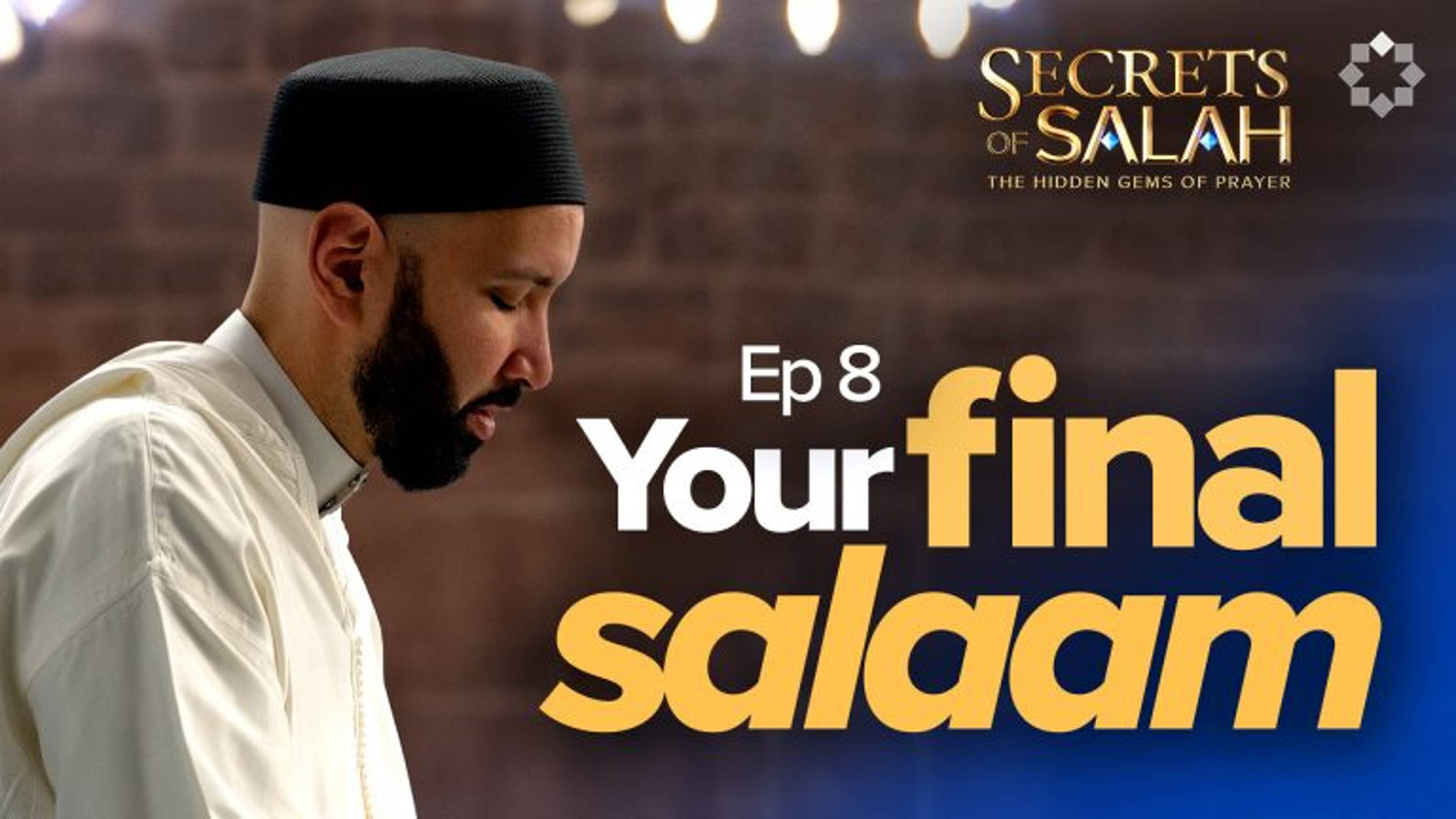
The Power of Verse 5 | Episode 5 | Secrets of Salah | The Hidden Gems of Prayer
Secrets of Salah | Dhul Hijjah 2025

The Power of Verse 5 | Episode 5 | Secrets of Salah | The Hidden Gems of Prayer

The conversation continues. Al-Fatihah is too profound to explain in a single episode. From the many implications of asking for guidance, to the hidden connections between this chapter and other surahs of the Qur'an, there is so much more to explore.

Dr. Omar Suleiman explains the opening chapter of the Holy Book. Join him to keep learning about what you recite 17+ times every day of your life.

Series recorded at Shehzade Korkut Mosque in Antalya, Türkiye

Find peace in your purpose. Donate to Yaqeen: https://yqn.io/88r1

Sign up for series updates here: https://yqn.io/0p7g

This transcript was auto-generated using AI and may contain misspellings.
00:00You don't go to Allah like one who's entitled, like He owes you anything. You go to Allah Subhanahu wa Ta'ala with a sense of vulnerability and brokenness, and that anything He bestows upon you is purely from His grace and not because of
00:12anything that you did to deserve that. Allah is the greatest, Allah is the greatest.
00:27The next verse is, Iyyaka na'budu, iyyaka na'budu, wa iyyaka nasta'een. You alone we worship and from You alone we seek help.
00:40These two notions here are so comprehensive in ridding us of any spiritual evil that could serve as a barrier between us and Allah Subhanahu wa Ta'ala and in perfecting our du'a. How?
00:53When it comes to worship, you alone we worship. So we don't mix intentions in our worship, right? We only worship Allah Subhanahu wa Ta'ala and no one else and nothing else in any way. But what about help?
01:08From You alone we seek help. Are we allowed to seek help from other people? Well, yes, but here's the thing.
01:15We recognize that everything that we use as a resource or any medicine or anything else or anyone else is only as good as what Allah Subhanahu wa Ta'ala allows it to be.
01:28And so the true help only comes from Allah Subhanahu wa Ta'ala. And so we don't have tawakkul, we don't trust in anything else. We trust in Allah Subhanahu wa Ta'ala.
01:37And the means are only as beneficial as Allah Subhanahu wa Ta'ala, who is the bestower of all means, allows them to be. So you alone we worship and from You alone we seek help.
01:50Some of the scholars like Ibn Taymiyyah rahimahullah, they said that this verse is the cure for riya and the cure for kibr. The cure for showing off and the cure for pride. These great spiritual evils. How? Riya, you alone we worship.
02:05So we don't worship for anybody else. We don't care who's watching and who's not watching. Right? We devote ourselves to Allah Subhanahu wa Ta'ala and we're not looking to be seen by other than Allah Subhanahu wa Ta'ala.
02:18So that is a cure for riya, a cure for showing off. And kibr, pride, iyyaka nasta'een, from You alone we seek help. So you break your pride, you break your ego. I can't do anything without You, oh Allah. I need You, oh Allah.
02:33Right? And so it breaks riya and it breaks kibr. There's a very famous set of books by Ibn al-Qayyim rahimahullah called Madarij as-Salikeen bayna manazil iyyaka na'budu wa iyyaka nasta'een.
02:46The stations of the seekers between iyyaka na'budu wa iyyaka nasta'een. Right? That is how comprehensive this verse is in terms of elevating our worship to Allah Subhanahu wa Ta'ala and removing the barriers between us and Allah Subhanahu wa Ta'ala.
03:01The scholars also mentioned that the reason why iyyaka na'budu precedes iyyaka nasta'een is that the first part is for Allah, which is worship. The second part, which is help, is for the servants.
03:13And Allah deserves all of our worship and all of our sincerity of our good deeds, whether He gives us anything further or not. Right? Allah Azza wa Jal deserves that from us and anything that comes beyond that is from His kindness and from His generosity.
03:28And so we affirm that and then we seek help. You don't go to Allah like one who's entitled, like He owes you anything.
03:34You go to Allah Subhanahu wa Ta'ala with a sense of vulnerability and brokenness and that anything He bestows upon you is purely from His grace and not because of anything that you did to deserve that.
03:46Also, the first one, iyyaka na'budu, is related to the hereafter. Why? Because when do you expect to be paid for your worship? Only in the hereafter. Right?
03:56Whereas when you seek Allah's help, that is related to this dunya as well, that you seek Allah's help for this world.
04:04And specifically, you seek Allah's help to perform good deeds and to remain guided while also being seen through the difficulties of this dunya. Also notice that you're addressing Allah directly. Not he alone we worship and from him alone we seek help.
04:19Iyyaka na'budu. You alone, O Allah, we worship. And from You alone, O Allah, we seek help. And what is Allah's response? Allah says,
04:32You see this statement, this is between Me and My slave. Even the angels, this is a bold claim. You're making the claim when you say iyyaka na'budu wa iyyaka nasta'een. This is a claim.
04:44This is an expression of closeness that we pray is real. But at the end of the day, some people say iyyaka na'budu wa iyyaka nasta'een, but they're loaded with riya and with kibr. So you're making the claim to Allah. You alone we worship.
04:59Are you sure? And from You alone, we seek help. Are you sure? It's also something to suggest that there are certain things that only Allah knows about you. Not even the closest angels to Allah know about you.
05:13And so when you make claims, when you make du'a, there are certain things of access that will only exist between you and Allah Subhanahu wa Ta'ala and nobody else. Now, again, as we said, now is the second half of al-Fatiha.
05:26So this is the first nusf, the first half. Look at the page. This is all praise of Allah Subhanahu wa Ta'ala. Now comes the big ask, which is your part of al-Fatiha. And that is,
05:39Guide us to the straight path. Guide us upon the straight path. Guide us with the straight path. Notice it doesn't say, Guide us to the straight path.
05:53It's just guide us the straight path. Here it's translated in fact, literally guide us the straight path. Because if you look at the beginning of Surah Al-Baqarah, you're asking Allah for guidance. The beginning of Ali 'Imran,
06:06Oh Allah, don't let us go astray after You guided us. Because you don't just want to be guided one time. You want to remain upon guidance. So guide us to the straight path, upon the straight path, with the straight path.
06:20Let guidance be our entire existence. So long as we are upon this earth to know the truth, to be made steadfast upon the truth and to never leave the truth.
06:31To be able to call the people to the truth and to have the strength to endure the harm that comes with calling people to the truth. As the people of da'wah, they have a different level when they interact with this notion of hidayah.
06:44And SubhanAllah, here you're asking Allah to guide you to proper beliefs and to the finer details. You're also asking Allah to guide you to leave off your sins.
06:54And you're asking Allah to guide you to all good pathways, all pathways to His guidance and to His love. وَالَّذِينَ جَاهَدُوا فِينَا لَنَهْدِيَنَّهُمْ سُبُلَنَا
07:05Allah says those who strive in Our way, We will guide them to Our paths. And so what are you asking Allah to be guided to? Just like you need to think about, visualize what you're praising Allah for.
07:17And then the Day of Judgment is very vivid, right? And you put yourself as if you're standing on the Day of Judgment. And you know that if you worship Allah, from Him alone you seek help. Now, what are you asking for, for guidance?
07:30Again, you're asking for Allah to guide you to proper beliefs, to guide you to the finer details that maybe you're not noticing, to guide you to leave off sin and to guide you to the pathways of good and to keep you upon that guidance the entire way.
07:45Allah Azza wa Jal also calls us Sirat al-Mustaqeem, the straight path. And so the straight path, Mustaqeem, means that there are no deviations. It doesn't wiggle right and left.
07:59And that the shaitan will call you away and take you away from that straight line. The believer is always in a singular direction to Allah Subhanahu wa Ta'ala.
08:09So away from all deviations and away from the things that hinder our pursuit of Allah Subhanahu wa Ta'ala. You know, one of the ways that Allah Azza wa Jal refers to this is through Ibrahim (alayhi salam). Ibrahim (alayhi salam) says to his father,
08:21Follow me and I'll guide you to a balanced path. Siratan Sawiya. It's perfect. Right? It's perfect.
08:30And if you think about the fitrah of the way of Islam, the nature of the way of Islam, that it's so obviously balanced, perfect, coherent. It makes sense. And that's why it appeals to so many people.
08:45So guidance is the most precious gift and the most precious thing that you could ask Allah Subhanahu wa Ta'ala for. And Allah Azza wa Jal warns us, don't be like those people who sold their huda for dalalah.
08:58They sold their guidance away for misguidance. I want to ask you this question, SubhanAllah. When you read Surah Al-Baqarah, you ever noticed what the first sale that's mentioned is? The first transaction?
09:09The very first transaction in the Quran is when Allah refers to the hypocrites. Ulaika allatheena ishtarawu dhalanata bilhuda. Those people who purchased misguidance with guidance. Allah gave them the gift of guidance and they purchased dalalah.
09:24They purchased misguidance with it. Fama rabihat tijaratuhum wa ma kanun muhtadeen. They neither gained from that sale nor were they amongst the guided. They benefited nothing from that sale.
09:37You also see that with guidance comes takbir and tahmid. When we finish the month of Ramadan, wa li tukbiru al iddata wa li tukabbiru Allah ala ma hada. You finish the period and you say Allah akbar for what He guided you to.
09:52And also alhamdulillah all praise be to Allah who guided us to this. So there's a direct connection between every one of the adhkar and the gift of guidance. Now Allah Azza wa Jal says,
10:05sirata allatheena an'amta alayhim. The path of those that You are pleased with. And when you think about this, this is the equivalent of how encompassing rabbil alamin is. The Lord of all the worlds.
10:19The path of those that You are pleased with. All of those that You are pleased with. Who does that include? That includes the prophets of Allah and the greatest people to ever live and the unknown wali of Allah Subhanahu wa Ta'ala that exists in the furthest corners of the earth.
10:33That includes every single person that Allah Subhanahu wa Ta'ala is pleased with. So Lord of all the worlds, the ones I know and the ones I don't know. That which I see and that which I don't see.
10:44And those that You are pleased with, those who I know and those who I don't know. Also, if Allah is pleased with you, then everything else falls into place.
10:54When Zakariya (alayhi salam) was making du'a for his son, Yahya (alayhi salam). One of the du'as he made was, waj'alhu rabbi radiya and make him, oh my Lord, pleasing. And the scholars say how perfect of a du'a because if he's pleasing to Allah,
11:09then Allah will make the angels pleased with him. And Allah will make the people on earth whose pleasure is worth having, also come to him as well. Right? That Allah Azza wa Jal will give him qabool on this earth, acceptance on this earth as well.
11:22So, an'amta alayhim, sirat alladheena an'amta alayhim refers to all of those people. min anabiyeen, was siddiqeen, wash shuhada, was saliheen.
11:32From the prophets to the truthful ones, to the martyrs and to as-saliheen, to all of the righteous ones. Those are alladheena an'amallahu alayhim. Those that Allah is pleased with. And so, you see the people of Gaza and you see what they're upon.
11:46The shuhada, was-siddiqeen, was-saliheen. You're asking Allah to be on the same thing that they're upon. Because what they have is absolutely amazing and we want to have that. That's in the present. In the past, this is why by the way, I teach the first, the sahaba.
11:59You want to know allatheena an'amta alayhim? Look at Abu Bakr, Umar, Uthman, Ali, Khadijah, Aisha and so on and so forth. These are the people who Allah is pleased with. You need role models. You need to know who they are. And if you know who they are, then you know how to follow them.
12:12And by the way, in here is a lesson that your role models are those who you admire for a very particular reason.
12:22And so, when it comes to our youth admiring certain athletes or people admiring influencers and celebrities and things of that sort, you have to ask yourself why? And how do you temper that?
12:35Because eventually that devotion could become a form of worship, right? Idol worship, the new idols, right? And they can become human beings who can do no wrong.
12:46And the Prophet (ﷺ) teaches us, la hasada, there's no envy except in the case of two people. A person who Allah gave knowledge to and he spreads it, and a person who Allah gave wealth to and he spends it in the way of Allah Subhanahu wa Ta'ala.
12:58Those are your role models. You want to admire people for the right reasons. Even envy them in a halal way, in a good way, right? Not that you want harm for them, but like I want to get to that level for the right reasons.
13:08So, sirata allatheena an'amta alayhim, I don't want to be on the path of those people who are famous, but famous for all the wrong reasons or not upon the right way.
13:19Instead, I want to be upon that way, which is pleasing to You, O Allah. ghayril maghdoobi alayhim, not those who have earned Your wrath. These are people that had guidance and they sold it for the anger of Allah, right?
13:32Those are the people who made that transaction. They knew and they willingly disobeyed. walad dalleen, nor those who have gone astray. These are people who never actually absorbed what true guidance was in the first place.
13:46And you're asking Allah to protect you from His anger. And you're asking Allah to protect you from going astray. And then you say, ameen. And everyone says, ameen.
13:59And SubhanAllah, there's something so beautiful about this. wa idha sa'alaka ibadi anni fa inni qareeb When My servant asks Me, I am close. I'm close. ujeebu da'wata da'i idha da'an I answer the call of the caller when he calls upon Me.
14:13The people of the book, they envied our ameen for a few reasons. One of them is the husn adh-dhann in Allah Subhanahu wa Ta'ala, the good expectation of Allah
14:23that you make the du'a and you make the du'a with confidence that He will answer. And Allah Subhanahu wa Ta'ala, what does He answer this with? hadha li'abdi wa li'abdi ma sa'al
14:35This is for My servant and for My servant, is that what he asked for? So there's the husn adh-dhann in Allah Subhanahu wa Ta'ala. And look at the opening of Surah Al-Baqarah. dhalika al-kitabu la rayba feehi hudan lilmuttaqeen You asked Allah for guidance. Here's your guidance.
14:49To show the immediacy of the response of Allah Subhanahu wa Ta'ala, you wanted guidance. I'm giving you guidance, right? So there's a husn adh-dhann in Allah, a good expectation of Allah that when you praise Him, He answers you right away.
15:02When you ask Him, He gives you what you ask Him for. And they envy that. They also envy that when the believers say Ameen, the unison. And so when the Imam says Ameen, the angels say Ameen.