Secrets of Salah | Dhul Hijjah 2025
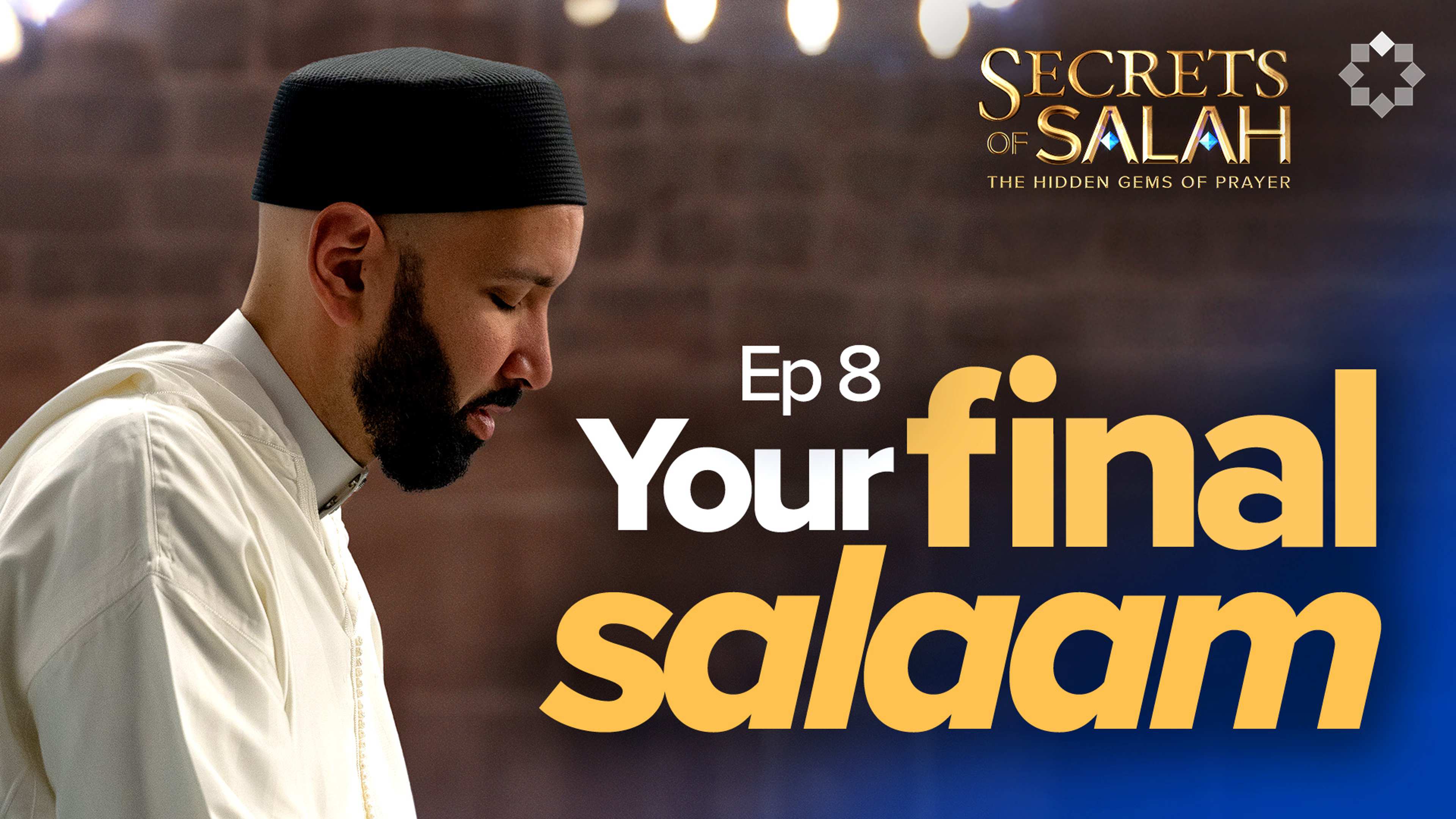
Why You Say the Tashahhud | Episode 8 | Secrets of Salah | The Hidden Gems of Prayer
The Prophet ﷺ taught the Tashahhud with the care of a surah from the Qur'an. This is the closing ceremony with the King of kings, where greetings arrive bearing gifts: you present your prayer, your character, and your sincerity.
In this episode, Dr. Omar Suleiman traces the precise language of the Prophet ﷺ, from “at-tahiyyatu lillah” to the kalimah that crowns your acts of worship. The sentence that seals your salah is the one you hope will seal your life.
Series recorded at Shehzade Korkut Mosque in Antalya, Türkiye
Find peace in your purpose. Donate to Yaqeen: https://yqn.io/88r1
Sign up for series updates here: https://yqn.io/0p7g
This transcript was auto-generated using AI and may contain misspellings.
00:00Imagine you die saying La ilaha illallah and then the angel comes in and says man rabbuk. I died saying La ilaha illallah. Who is your Lord? Right? How beautiful would that be? May Allah make it our last words and allow us to seal our lives with kalima as we seal our salah with kalima.
00:14Allah is the greatest. Allah is the greatest.
00:26Then you go to at-tashahhud. Companion said that the Prophet (ﷺ) would teach us the tashahhud like he would teach us a surah from the Qur'an. And what that means is its importance and its wording
00:41are with precision. So the importance like a surah from the Qur'an and the words are profound, very deliberate, very precise when you ask Allah Subhanahu Wa Ta'ala. I want you to think about this like the closing ceremony with the king of all kings.
00:57So the rak'ah is a complete mini salah in a way. In the Prophet (ﷺ) said whoever catches the ruku' it's as if they caught the rak'ah. Okay? And so now you're in the closing ceremony
01:12with Allah Subhanahu Wa Ta'ala and you're addressing the Lord of the worlds in such a beautiful way. Now there are five authentic variations of tashahhud. The Prophet (ﷺ) taught
01:25them to five different companions and they're all authentic. The most famous one is the variation of Ibn Mas'ud (رضي الله عنه). Very slight variations by the way between the five. They all pretty much mean the same thing. Right? Very slight variations. But we recite,
01:40majority of us, the variation of Ibn Mas'ud (رضي الله عنه). So you start off with
01:49All greetings are to Allah. Addressing the king in this closing ceremony of your salah. If you remember, alhamdulillah. All the praises. Al is the definite article. All the praises are
02:03to Allah. Here, not tahiyyat. At tahiyyat. By the way, SubhanAllah, I was thinking about this, you know, like some people in the slang, especially like I'm Palestinian so I can take shots at my own in this regard. I'm going to say alhamdulillah. They won't say alhamdulillah.
02:19They'll even type it out. Alhamdulillah. No offense to the Palestinians. Right? But it's many Arabs and many people say alhamdulillah. Alhamdulillah is very different. At tahiyyat.
02:31All of the greetings belong to Allah. All of the greetings are encompassed. So al is the definite article. And so at tahiyyat is equivalent to alhamdulillah, but it's a royal address.
02:46It's not directly connected to an ask. And by the way, this is only a way that you address Allah. You can't say as-salamu ala Allah. Khadija (رضي الله عنها), she had that aqeedah,
02:56by the way, that creed understood when Jibreel (عليه السلام) said salam to her. We'll come back to that in a bit, inshallah. On behalf of Allah and on behalf of Jibreel, right? She said, as for
03:06Allah, he is as-salam. Allahumma anta as-salam. Right? But at tahiyyat lillah, it's to the Lord of the worlds. It's a royal greeting to Allah Subhanahu Wa Ta'ala. A royal formal greeting
03:21to Allah Subhanahu Wa Ta'ala. At tahiyyat lillah, to Allah. Was-salawatu wat-tayyibat.
03:28So as-salawat, all worship is directed to him. Iyyaka na'budu wa iyyaka nasta'een. Right? As-salawat, all worship is directed to him. At tayyibat, some of the scholars say all of the extra dhikr
03:41and du'a that comes in the salah. If you're talking about it in the capacity of the salah itself. So as-salawatu wat-tayyibat, as-salawat would be all worship and then the salah itself
03:52and then at tayyibat would be the dhikr that comes with it in that regard. Tayyibat also, some of the scholars mentioned, are all good things that can only be attributed to Allah
04:03Subhanahu Wa Ta'ala. Okay? But if you think about the words of dhikr, they're all at tayyibat.
04:09Right? Al-kalimatu tayyib, the pure word is la ilaha illallah. Right? That is the pure word. So at tayyibat are the words of dhikr, the words of remembrance and all the good things that are
04:23only attributed to Allah Subhanahu Wa Ta'ala and are directed to Allah. Some of the scholars said as-salawat is worship. At tayyibat is the good character that emanates from that worship.
04:33So all of these meanings give the idea that as-salawat encompasses the realm of ibadah, at tayyibat is what is built upon that realm of ibadah. Some of the variations mentioned
04:44mubarakat, baraka, mubarakan fee. Okay? So blessed within. And of course we know that the Prophet (ﷺ) said, inna allaha tayyib, Allah 'azza wa jal is tayyibun, he is pure
04:56and he does not accept la yaqbalu illa, he does not accept except for what is tayyib, what is pure. Right? So you are ascending to Allah Subhanahu Wa Ta'ala, all blessed things. Ya Allah, this
05:09worship was performed for you. What was in addition to this worship was performed for you. The good of it belongs to you. What was enabled belongs to you. Everything in my life of worship
05:20and goodness belongs to you. So I'm not giving you empty greetings. I'm not giving you empty greetings. And notice by the way that this comes at the end of the salah. Right? You know, someone
05:31says, I don't pray, but I worship Allah in my own way. I worship Allah. I have a great relationship with Allah, but I don't pray. I pray in my heart. Okay? That's your excuse on the day of judgment.
05:44I pray in my heart. Now the Royal address to Allah Subhanahu Wa Ta'ala, you mentioned the greetings and you mentioned what you brought with the greetings. You present gifts with greetings,
05:52right? You go to someone of stature, you don't go empty handed. So the gifts that you're presenting in this Royal ceremony to Allah 'azza wa jal, the King of Kings as you depart, are your
06:05ibadat and at-tayyibat. And then you say, As-salamu alayka ayyuhan nabi. Peace be unto you, O Prophet. Allah Subhanahu Wa Ta'ala says in the Quran,
06:17Qul alhamdulillahi wasalamun ala mursal. Right? Qul alhamdulillahi wasalamun ala ibadihi allatheen astaghfiru. Say alhamdulillah and then send peace upon the messengers or peace upon those whom Allah
06:29has chosen. And the best of those who Allah has sent and the best of who Allah has chosen is al-Mustafa, Rasulullah Muhammad (ﷺ). And so the best of all creation,
06:42you send salam upon him, (ﷺ). You think about how in the salah, Iyyaka na'budu wa iyyaka nasta'een. You address Allah Subhanahu Wa Ta'ala directly. And there's a personal beautiful element to that. Now, when it comes to the Prophet,
06:54(ﷺ), you're not talking directly to the Prophet, (ﷺ). Right? You're not talking directly to the Prophet, (ﷺ). In fact, in the Surah, there's a narration that when the Prophet, (ﷺ), passed away, we didn't say, as-salamu alayka ayyuha nabi, we said, as-salamu ala nabi. That was his opinion
07:09and some of the scholars in that were, some of the sahaba. But, you know, just peace be upon the Prophet. When he was alive, we would say, as-salamu alayka ayyuha nabi, peace be on to you, O Prophet. The majority of the scholars say we continue the way that it was taught to us by the
07:23Prophet, (ﷺ). And so, as you're saying it, you know, imagine standing in front of the Prophet, (ﷺ), and saying, as-salamu alayka ayyuha nabi, peace be
07:33upon you, O Prophet. Right? As-salamu alayka ayyuha nabi. And there's something so sweet, so beautiful about that closeness that we feel upon us. Even though we never saw him,
07:45even though we did not live his time, (ﷺ), we still feel that incredible closeness to him, (ﷺ). Now, we're living a beautiful interaction with this entire exercise.
07:57And that interaction is the one that I alluded to. When Jibreel (عليه السلام) came to the Prophet, (ﷺ), in Mecca, and he said, hadihi khadijah, that's khadijah coming to you.
08:07When she comes, give her salam from Allah, and give her salam from Jibreel, and give her the glad tidings of a home in Jannah, in which there is no fatigue and no tiredness. A beautiful home,
08:20made of a very precious type of pearl. And Khadijah, (رضي الله عنها), responded, and she said, as for Allah, he is as-salam. And as for Jibreel (عليه السلام). And she responded
08:33with salam on the Prophet, (ﷺ). Even though the Prophet, (ﷺ), was conveying the salam of them, but in her adab and love and beautiful character and conduct towards the Messenger of Allah, (ﷺ), as-salamu alayka ayyuha nabi. She sent her salam
08:46to the Prophet, (ﷺ), as well. She included him in that interaction, (ﷺ), wa (رضي الله عنها). And Allah 'azza wa jal rewarded her with what
08:56he rewarded her with. And here's the thing as well, as-salamu alayka ayyuha nabi. And then what do you say? As-salamu alayna wa ala ibadillah as-salihin. And upon us and upon the righteous servants of
09:11Allah, Subhanahu Wa Ta'ala. Something very powerful and beautiful about this. The initial recitation of the tashahud was as-salamu ala Allah, as-salamu ala Jibreel, as-salamu ala Mikail.
09:26Okay, this is the way that it's narrated from a narration of Shafiq ibn Salama that we used to recite that the Sahaba were saying as-salamu ala Allah, as-salamu ala Jibreel, as-salamu ala Mikail.
09:41And the Prophet (ﷺ), he said to them, instead say as-salamu alayna wa ala ibadillah as-salihin. Instead say peace be on to us and upon the righteous servants. He said,
09:53fa innakum idha kultumuha, because if you say that, then asabat kullu abdin lillahi salihan fissama'i wal-ard. Then that will reach every slave of Allah Subhanahu Wa Ta'ala who is salih,
10:07salihin, fissama'i wal-ard, in the heavens and the earth. Meaning what? There's still something very beautiful that you can think about Jibreel (عليه السلام) and Mikail and Israfil and the angels
10:20who are being included in that. And you can think about all the Naseem jibreel Allah that are being included in that. You can think about all of the Sahaba and all those beautiful people in that.
10:30So the idea here is that the praise is an order of rank. And in the way that we recite, the Prophet (ﷺ) deservedly so has his takhsis, his specification. But everyone
10:45else, this is just like allatheena an'amta alayhim, those that you are pleased with. It's left open to include everybody that is from as-salihin. And in the categories of nabiyyin,
10:59siddiqeen, shuhada, salihin. Salihin is the catch-all because all of those categories are righteous. And so you have an all-encompassing category of as-salihin. You're asking Allah to
11:12send his peace upon all of the righteous and you're praying to be amongst them as well. This also shows you're praying for your ummah at all times. So the people of Gaza, the salihin are in your mandatory salah du'a.
11:30And then you say, Think about the coherence of this, by the way.
11:42The idea here is that the greatest manifestations of tawhid, of monotheism, are in what you've just said and done in your salah. So think about how full your shahada is at this point. That I testify that there is no god worthy of worship or unconditional obedience except for you.
11:58You have no partner. Everything you've just did, everything you've just done before that moment, is a testimony to that tawhid. Right? From what you were reading to the postures that you were manifesting. So,
12:13Same thing, by the way, you say at the end of your wudu. Right? And the same thing that is at the end of the adhan. And then you say,
12:27And I bear witness that Muhammad (ﷺ) is his slave and his messenger. There's so much to unpack here. Number one,
12:37The Prophet (ﷺ) is the ultimate, who Allah 'azza wa jal is pleased with. There is no way to access guidance without him as a rasool, as a messenger. And there is no way to
12:50manifest your own ubudiyyah, your own servitude, except by following his example as a abdu of Allah. So when he's mentioned as a slave of Allah here, first of all, when Allah takes you as a slave, mentions you as a slave, that's the greatest honor.
13:04Because al-Masih, as Allah says, Jesus peace be upon, and the closest angels, Jibreel and the prophets were not too proud to be ibad of Allah. Because the more that you lower yourself to Allah, the more he exalts you. So the more you immerse yourself in ubudiyyah
13:19and servitude to Allah, the higher you actually become. So this is not a belittling of the Prophet (ﷺ), but you need the Prophet (ﷺ) as a abdu and as a rasool, in the sense that you follow his example of ubudiyyah,
13:33of servitude and slavery to Allah Subhanahu Wa Ta'ala. And you follow his example (ﷺ) as a messenger, because he is the vehicle of guidance. So the vehicle of guidance
13:45as a rasool, the manifestation of perfect ubudiyyah as a messenger of Allah (ﷺ). You're a loving slave of Allah Subhanahu Wa Ta'ala, a devoted slave of Allah Subhanahu Wa Ta'ala.
13:56You relish in being a slave of Allah Subhanahu Wa Ta'ala. You enjoy it, right? And you find elevation in it, in this life and in the next. Now here, SubhanAllah, the scholars would mention
14:09that you've sealed your salah with shahada. Wudu is sealed with the kalima. Adhan is sealed with the kalima. Salah is sealed with the kalima. And what your hope is, is that your life
14:22will be sealed with the kalima. The Prophet (ﷺ) mentioned, whoever's last words are la ilaha illallah, dakhal al-jannah, will enter into paradise. And it is heavier on the tongue and on the heart in those dying moments than any other word. To be able to
14:36say la ilaha illallah in those closing moments of your life. May Allah 'azza wa jal allow us to have the shahada be our last words and to have us be raised with it. Imagine you die saying la ilaha illallah and then the angel comes in and says man rabbuk. I died saying la ilaha illallah. Who is your Lord?
14:51How beautiful would that be? May Allah make it our last words and allow us to seal our lives with kalima as we seal our salah with kalima.