Since the coronavirus spread across the world—infecting more than two million and taking over a hundred thousand lives—many Muslims have wrestled with pressing questions of the heart: Is this pandemic a punishment from Allah? Is He angry with us? Or could it be a blessing, a test, or a punishment all at once? These questions cannot be answered responsibly without first grasping what punishment means within Islamic theology, for the term carries many meanings—trials, rebukes, reprimands, penalties, and disciplinary actions that may manifest either in this world or the Hereafter.
In the Hereafter, the gravest punishment is the Hellfire, and it is meted out only after Allah brings His servants to account on the Day of Judgment with His perfect justice and mercy. Such punishment varies in severity and duration according to the extent of one's wrongdoing against oneself and others, just as reward varies according to one's righteousness. Ibn al-Qayyim described the Fire as a means of purification, saying, "The Hellfire was created to frighten the believers and to purify the sinners and criminals... Had it purified itself here through genuine repentance, good deeds which erase [sins], and calamities which atone [for sins], it would not have needed to be purified there." Thus the believer keeps both reward and punishment before his eyes, for they spur him toward righteousness and away from what does not befit faith.
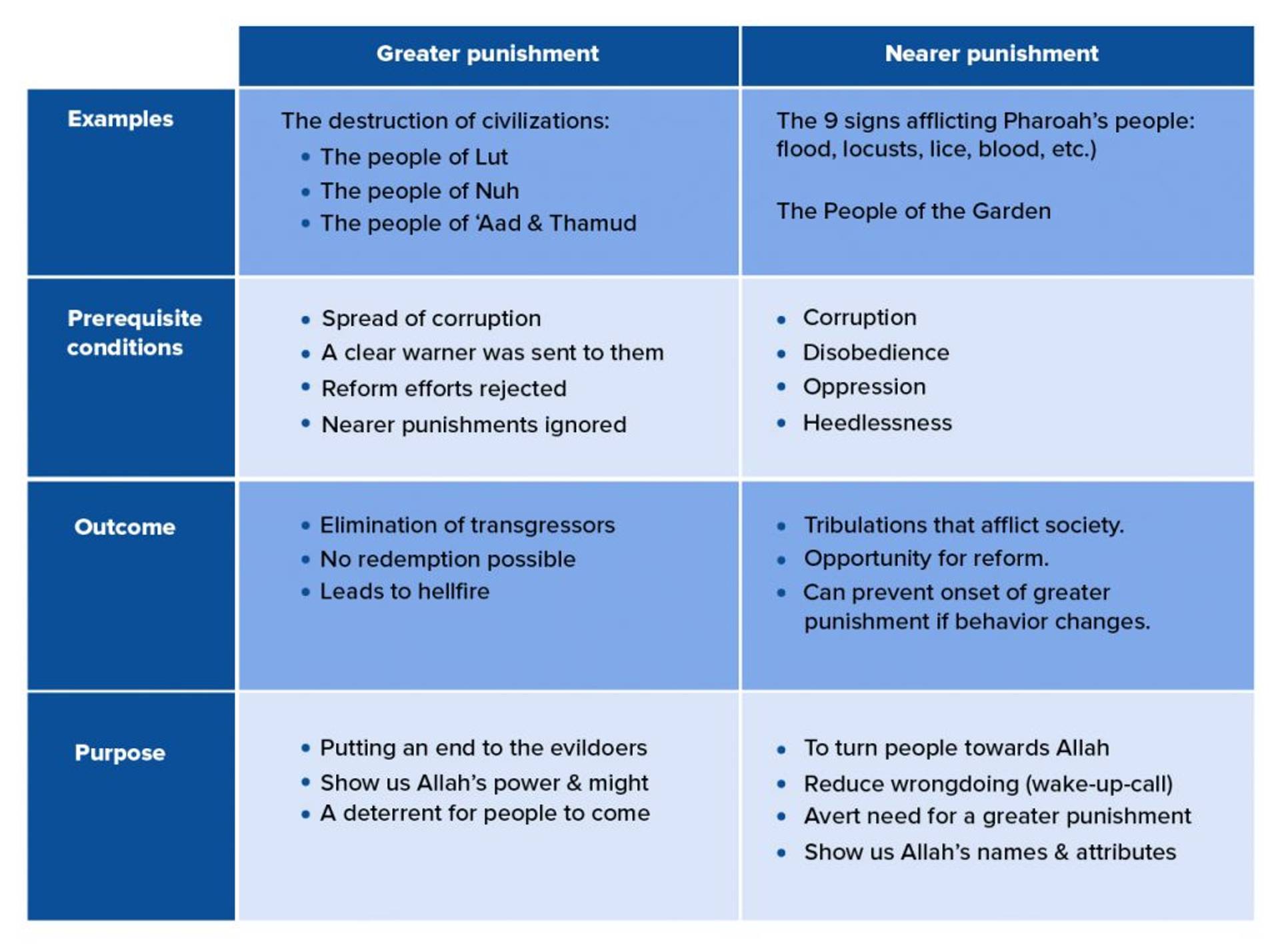
As for worldly punishment, the Qur'an distinguishes two kinds. The first is retributive—a decisive judgment leaving no path to redemption. Allah says, "Rather, it will come to them unexpectedly and bewilder them, and they will not be able to repel it, nor will they be reprieved." This form comes only after specific conditions are met: the sending of a prophet, the society's rejection of him, persistence in corruption, and the spurning of repeated warnings. Its purposes include ending oppression, supporting a prophet, manifesting Allah's attributes of majesty against a rebellious nation, and teaching later generations. Allah describes how such punishment destroyed earlier nations: "So each [nation] We seized for their sin; and among them were those upon whom We sent a storm of stones... and among them were those whom We drowned. And Allah would not have wronged them, but it was they who were wronging themselves."
The second kind is not a final verdict but a deterrent meant to bring people back to Allah and reform society. Allah says, "And We will surely let them taste the nearer punishment short of the greater punishment so that perhaps they will return." Many of the Prophet's companions ﷺ and early scholars understood the "nearer punishment" as the hardships, ailments, and tribulations of this life through which Allah encourages His servants to repent—so that its very purpose is to draw them near to Him. This is reinforced by His words, "Corruption has appeared throughout the land and sea because of what the hands of people have earned, so He may let them taste some of the consequences of what they have done so that perhaps they will return." These afflictions are therefore best understood as compassionate reprimands for humanity's betterment.
Though it may seem strange that punishment can flow from compassion, it becomes clear when the aim is to relieve suffering and restore harmony—like bitter medicine that heals despite its pain, and this comes from the One who is more merciful to us than our own mothers. Ibn al-Qayyim captured this beautifully: "A compassionate doctor may cauterize the sick person, searing him with fire over and over again, in order to remove from him the foul elements that sabotaged his natural state of health. And if [this doctor] sees that amputating the limb is better for the sick person, he severs it, causing him by that the most severe pain." Reward and hardship both shape behavior, as Allah says, "And We tested them with good and bad so that perhaps they would return."
A striking illustration is the people of the garden (aṣḥāb al-jannah) in Sūrat al-Qalam, who conspired to deny the poor their customary share of the harvest, only to find their garden destroyed by morning. After blaming one another, they took responsibility, sought forgiveness, and said, "Perhaps our Lord will exchange for us something better than it. Indeed, we are toward our Lord desirous." Had Allah not subjected them to this "nearer punishment," they might never have turned sincerely to Him and might have faced accountability in the Hereafter instead.
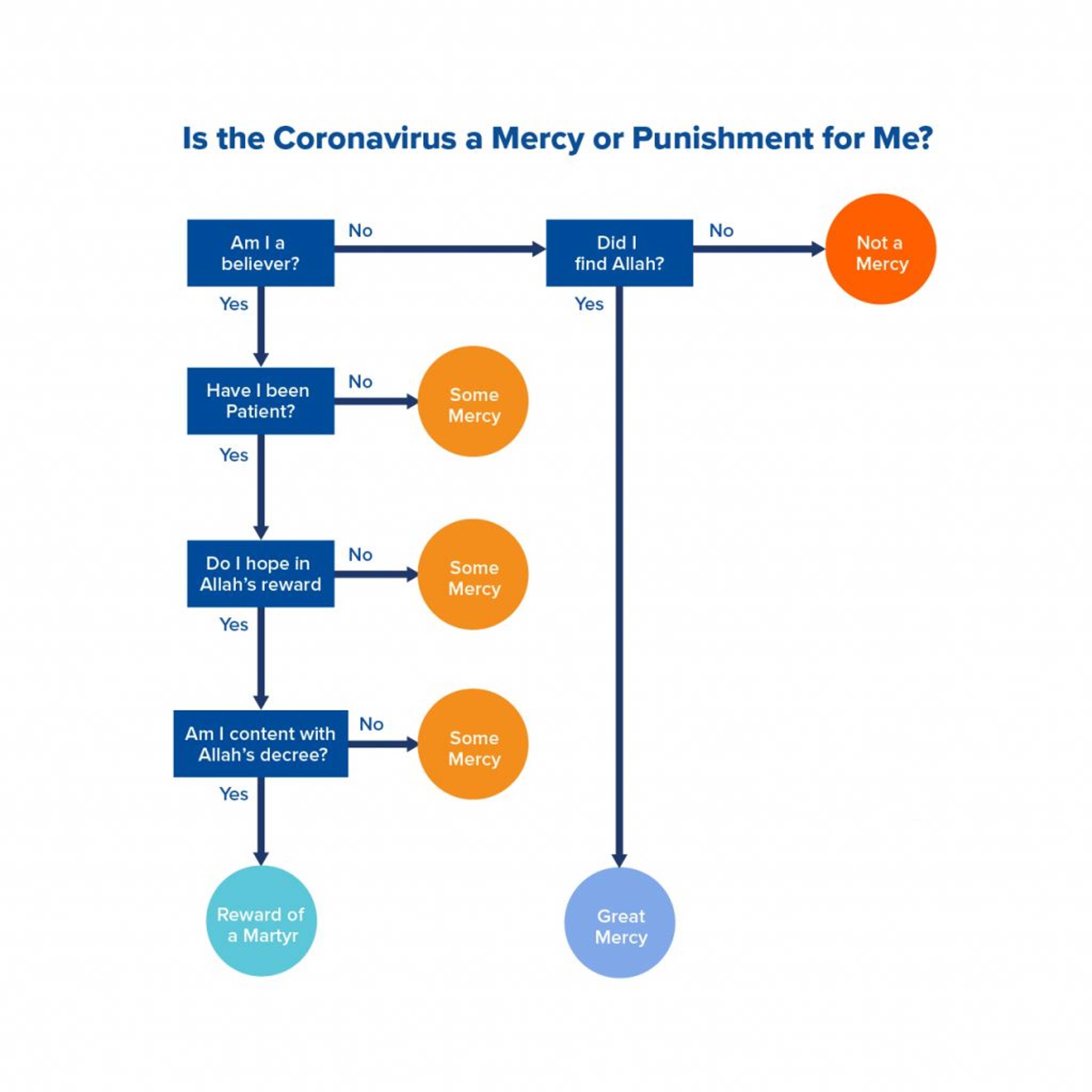
The benefit or harm of such trials differs from person to person. Al-ʿIzz ibn ʿAbd al-Salām said, "In tribulations, trials, misfortunes, and calamities lie a number of benefits; these benefits have differing degrees of relevance, differing in accordance to the various ranks of people." One who endures pain with patience may have his sins expiated, and one content with Allah's decree may be raised in rank; the "nearer punishment" only becomes a further punishment for those who object to the decree and act in ways displeasing to Allah.
A word of caution regarding qadar is necessary: though the sources confirm that afflictions, including plague-like epidemics, may be "nearer punishments," it lies beyond human perception to identify the precise cause of any specific affliction. To claim the coronavirus is a punishment upon a particular nation such as China, or for a particular reason, is mere conjecture—and its global spread shows it is not aimed at one people. Allah warns, "Or do you speak about Allah that which you do not know?"
The nearest precedent is ʿĀishah's question to the Prophet ﷺ about the plague, to which he replied, "It is a punishment that Allah sends upon whomever He wills, but Allah has made it a mercy for the believers. Any servant who resides in a land afflicted by plague, remaining patient and hoping for reward from Allah, knowing that nothing will befall him except what Allah has decreed, will be given the reward of a martyr." Though the coronavirus is not technically the plague, both are painful, potentially fatal infectious diseases, so it is reasonable to apply this teaching. Ibn Ḥajar explains that the punishment in this hadith is hastened in the world before the Hereafter and results from widespread moral corruption—yet, at both the societal and individual level, it may become either a further punishment or a mercy. For the believer who is patient, quarantines appropriately, hopes for reward, and accepts the divine decree, it may be a great mercy, even carrying the reward of martyrdom.
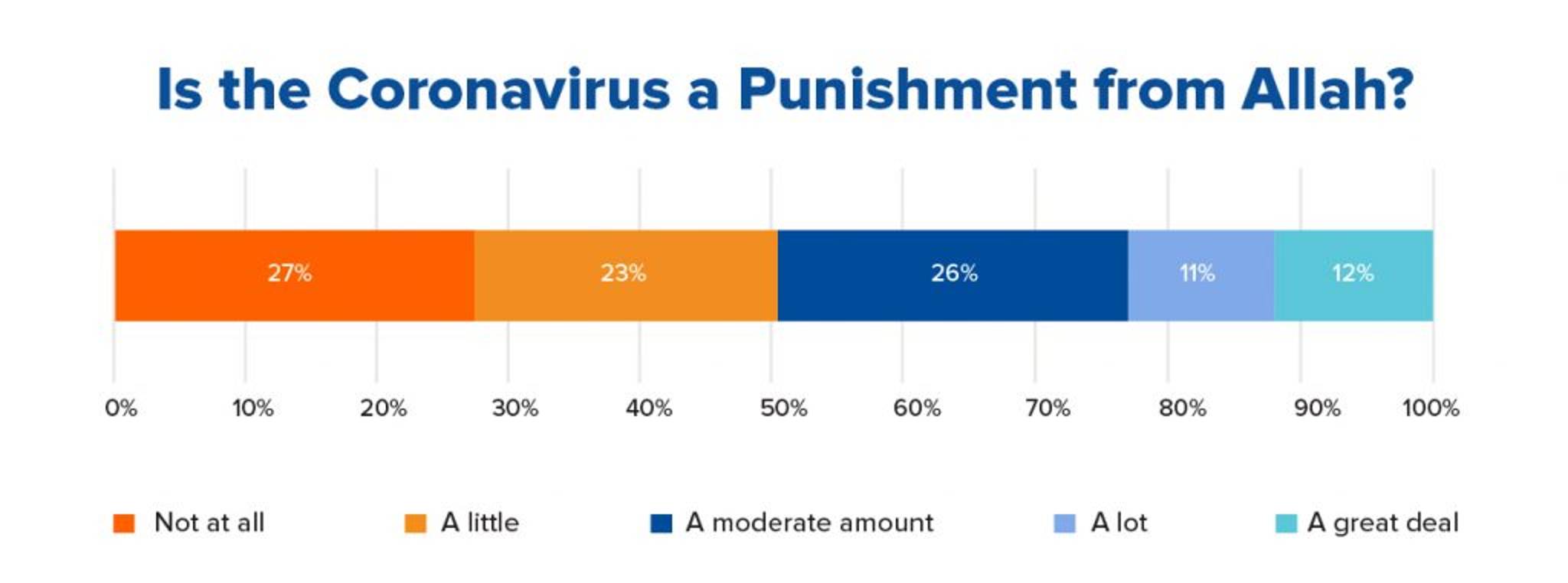
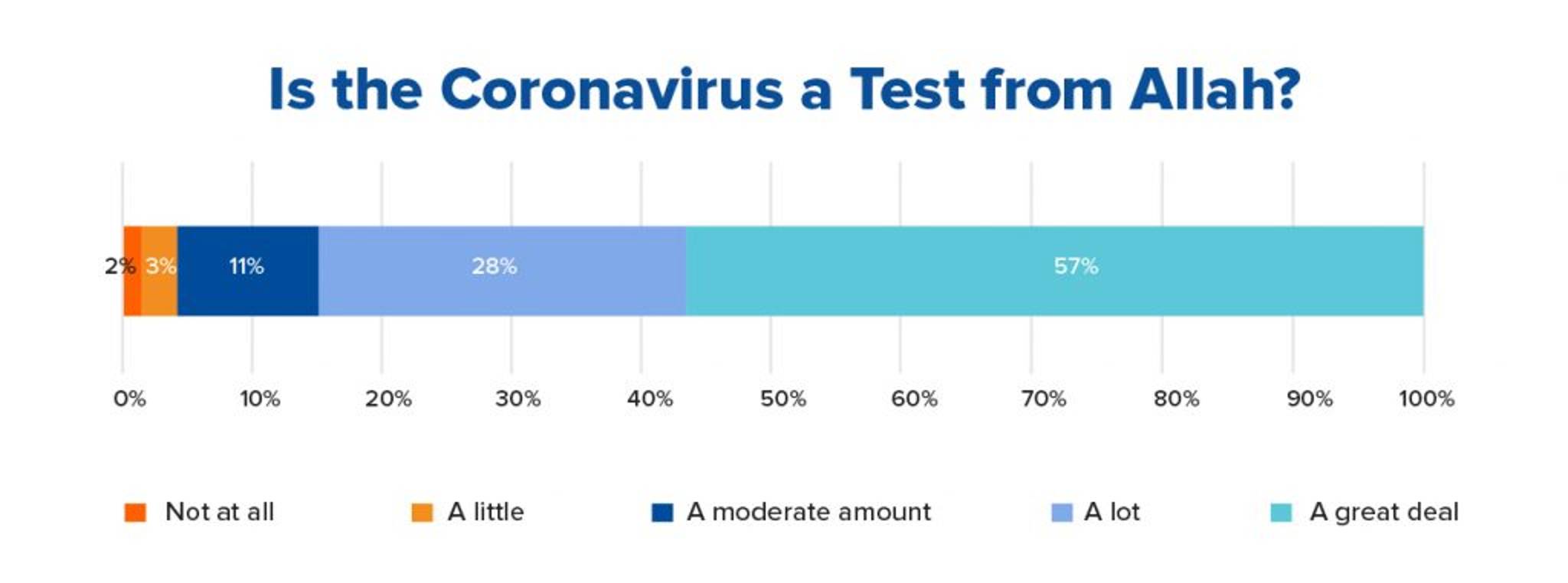
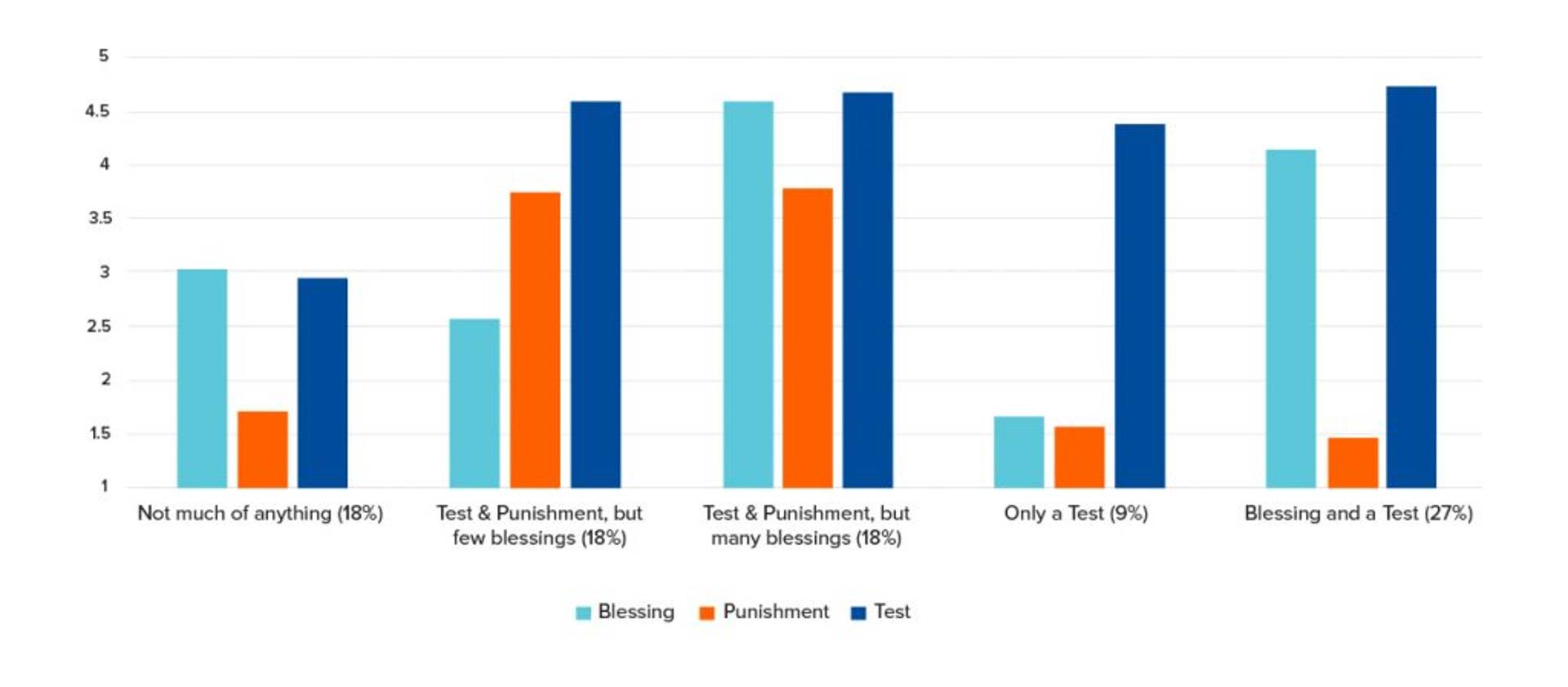
To ground these matters, Yaqeen Institute surveyed over 1,800 American Muslims, diverse in age, education, and race, and generally religious. When asked whether the coronavirus was a punishment, 27% said not at all, 26% a moderate amount, and 12% a great deal; 84% believed it a major test from Allah; and 53% reported witnessing many blessings, while 20% saw few or none. Cluster analysis revealed five patterns of belief: "Not much of anything" (18%), who did little religiously; "Test & Punishment, but Few Blessings" (18%), with more reported anxiety; "Test & Punishment, but Many Blessings" (28%), who read Qur'an and coped religiously more, mostly men; "Only a Test" (9%), the smallest, with less religious coping; and "Blessing and a Test" (27%), who read Qur'an and coped religiously more, mostly women. Those who read the Qur'an regularly were more likely to perceive blessings even while seeing a nearer punishment, and viewing the crisis solely as punishment and test appeared linked to greater anxiety.
Since pinpointing the true nature of the coronavirus may be impossible, the better question is how we have responded. When a Bedouin asked the Prophet ﷺ about the Hour, he replied, "And what have you prepared for it?"—teaching us to turn from the unseen toward our own response. Likewise, when the wind blew strongly, he would raise his hands saying, "O Allah, I ask You for its goodness and I take refuge with You from its evil," accounting for every possibility. So whether it is a punishment, a wake-up call, or a test, we ask Allah for its good and seek refuge from its evil; we seek forgiveness, rouse ourselves from heedlessness, and remain patient—thereby ensuring it becomes a blessing.
To guard against punishment, the believer works at both individual and societal levels—being "mindful of Allah so that Allah is mindful of" him, and serving as an agent of social welfare, for Allah mentions that the presence of reformers prevents the destruction of societies. Several practices are highlighted: faithful gratitude, for Allah says, "What would Allah benefit from punishing you if you are grateful and faithful?"; seeking forgiveness, for "Allah would not punish them while they continue to ask for forgiveness," and the Prophet said that constant seeking of forgiveness brings relief and unexpected provision; charitable giving, since "Charity extinguishes the anger of God" and will shade a person on the Day of Judgment; social distancing, echoing ʿAmr ibn al-ʿĀṣ's words during the plague of ʿAmwās, "Plague is like fire and you are its fuel. Therefore, disperse"; and steadfastness in maintaining good changes after relief comes, lest we forget our promises to Allah as He describes of those saved from crisis.
In conclusion, the coronavirus may be a difficult test, a compassionate reprimand, or both, yet Allah intends good for His servants and desires to draw them near, being "more merciful to His servants than a mother is to her child." The believer should be introspective, knowing that his reaction determines whether it becomes punishment or blessing, and that through patience, hope in reward, and contentment he may attain the rank of martyr—finding solace in the Prophet's words after Ṭāif, "As long as you are not displeased with me, I do not care [what I face]."