I want to welcome you all back to our class on the signs of the Day of Judgment, and Bismillah ta'ala, now things are going to start to get very interesting in terms of what the future looks like in accordance with what the Prophet salallahu alayhi wa sallam told us was to come, but anywhere there is a previous manifestation, we're going to talk about how the Sahaba interacted with that, and then how it comes down to us.
And it was just something really interesting that I was thinking of, if you look at the ten major signs of the Day of Judgment, my goal inshallah ta'ala by the way is that you'll, through repetition, you'll memorize some of these things, like the hadith with A'uf ibn Malik, the six things the Prophet salallahu alayhi wa sallam foretold, or the ten major signs of the Day of Judgment through repetition.
Of the ten major signs of the Day of Judgment, they're actually very easy to memorize, because three of them are of the same genre, right? So start telling me what you know of the ten signs of the Day of Judgment, the major signs, not the minor signs.
The sun coming from the west, good. Okay, what else? The coming of al-Dajjal, what else? The beast, what else? Tall building is not a major sign. What is it? Yeah, Yajuj and Majuj, what else?
Ad-Dukhan, what else? There's someone that comes along with Masih ad-Dajjal that's very obvious, but you guys skipped, okay, good. Okay, so you have Isa, what else? Three landslides, three landslides that the Prophet salallahu alayhi wa sallam mentions. Three landslides, and then he also mentioned, alayhi assalatu wassalam, not the Mahdi, the Mahdi is not of the major signs. What else?
A fire, right, that would gather the people for the ultimate reckoning. All right, now think about this for a moment. And it's just something that occurred in my mind as I was preparing for this particular lesson.
Of the 10, it's very interesting that at least six of them are natural phenomena. Six of the 10 are natural phenomena. Maybe if you include the beast, the Dabba, it's also a natural phenomenon that has a precedent in a minor sign.
Now, as I said, every single thing from the minor signs, when you look at the major signs, it's like its ultimate manifestation. So let me do the ones that are not natural phenomena. You have the ultimate villain, al-Dajjal. And you have villains throughout history that are represented through the minor signs of the Day of Judgment, false prophets and antichrists and murderers throughout the times, right?
But you have the ultimate villain. You have the ultimate hero in Isa alayhi assalam. And before Isa alayhi assalam, you have mujaddideen, you have heroes and revivers, and you have the Mahdi, right, coming as the last of those revivers before he comes.
You have Yajuj and Majuj, an army that wreaks a lot of corruption and an army that defeats them. This is a huge part of human history right here, right? Everything else starts to fall into natural things, right?
So you have the beast, which again, a talking beast, we'll talk about that. But then you have the sun rising from the west instead of the east, three landslides that will basically remove portions of the earth and force people to small areas, and then a fire that will ultimately take them to the place of al-Mahshar and ad-Dukhan, the smoke, right?
So you have natural disasters that represent five of the 10, natural phenomena that represent six of the 10, and perhaps even seven if you include the beast. Why is this so important?
Because the prophet Isa alayhi assalam, when he talks about signs of the day of judgment, there are signs that arrive through empires and through these major episodes in history.
Then there are signs that arrive through daily behaviors and people just are not paying attention anymore. So things that crept into our way of being that are corrupt and that are strange, right?
And then you have signs that come through diseases and fires and earthquakes and natural disasters.
And you know, the most annoying thing in the world for someone who gets a lot of flights canceled is when you go and you try to get a refund and they say it was an act of God.
Right, brother Fazl? Act of God, right? So they tell you the travel is canceled because it's an act of God, natural disaster, and you're like, Subhan'Allah. Can't do anything about it. And of course, in Dallas, we have a lot of those. Bad weather.
And the prophet Isa alayhi assalam taught us that natural disasters are usually not as natural as you think they are. But there is a lot more to these natural disasters. And he taught us how to interact with everything that's happening around us.
When nature starts to act different, when nature starts to act contrary to what we know of the nature of nature, like it starts to rebel. Okay, and this is a huge genre of the signs of the day of judgment.
And how did the messenger of Allah salallahu alayhi wa sallam used to interact? He said,
When the wind started to blow, you could see the anxiety on the face of the prophet salallahu alayhi wa sallam. Subhan'Allah, the person who has the least to worry about, worried about what we would just say, oh, that's a strong wind.
Or, oh my God, what a strong wind. Or, you know, I hope hail doesn't come through that. And I hope it doesn't become a tornado. And I hope it doesn't become that.
The prophet salallahu alayhi wa sallam, if the wind blew a little bit strong, it forced him to rush into sujud in the masjid. Prostration in the masjid. He said in another narration from Abu Hurayrah radiyallahu ta'ala anhu,
The wind is from the mercy of Allah subhanahu wa ta'ala. By the way, one of the reasons why translations can really mess you up is because when I looked at the, I'm not going to say which website, but it said, Wind is from the spirit of Allah. So it's translating ruh to ruh.
Now, and be careful from your AI, right? The prophet salallahu alayhi wa sallam said, It's from the mercy of Allah subhanahu wa ta'ala. Very interesting. He said, salallahu alayhi wa sallam, it comes with mercy and punishment.
Do not curse the wind. Ask Allah for its good and seek refuge in Allah from its bad. What does that mean?
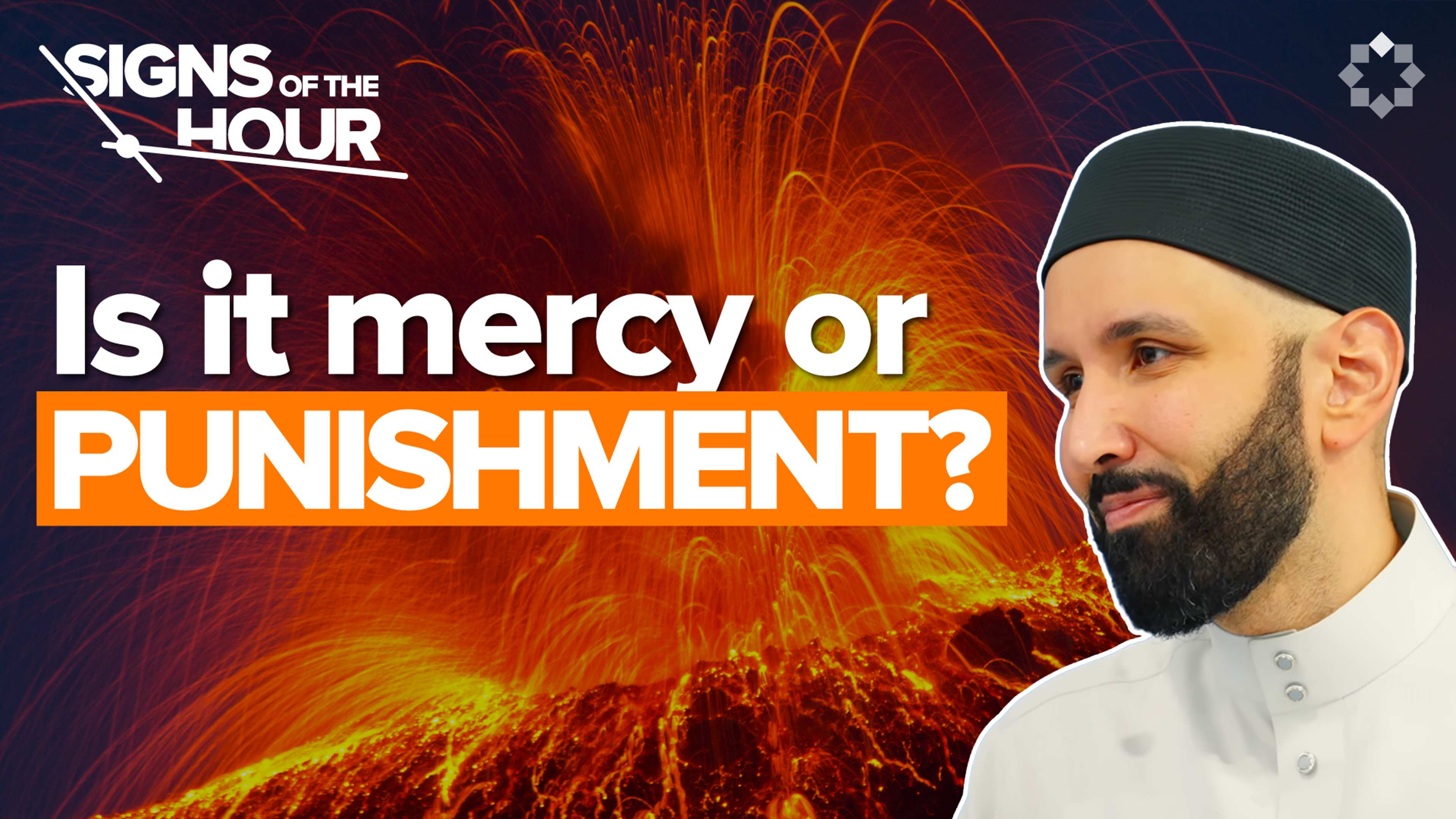
The same natural event can happen and it can be a mercy for some and it can be a punishment for others. This is another principle that we're taking from how the prophet salallahu alayhi wa sallam is going to lay out natural phenomena for us. He even said, salallahu alayhi wa sallam,
That I was made victorious with the wind from the East. As-Saba is the wind that comes from the East and the people of Ad were destroyed by the wind that came from the West.
When the prophet salallahu alayhi wa sallam was able to overcome Quraysh, partly because Allah sent a wind upon them like the wind of Ad that destroyed them and made it hard for them to continue their siege on the messenger of Allah salallahu alayhi wa sallam.
So that's another principle we take that when nature starts to seem strange, we look at it and we say this is either azab or rahma. This is a punishment or a mercy.
Oh Allah, count me of the camp of mercy, not of the camp of punishment. The messenger of Allah salallahu alayhi wa sallam in the hadith of A'uf ibn Malik.
Remember, always go back to that tent in Tabuk. He calls A'uf ibn Malik into his tent and he tells him count six signs before the day of judgment. You should know the first two clearly now.
Qala mawti, I'll give you the benefit of a doubt for now. My death, he said my death salallahu alayhi wa sallam. And then he said, does anyone remember from last time? No?
In this particular hadith, we said the six things he mentioned, give us six genres of the minor signs of the day of judgment. The second one was the conquest of what? Bayt al-Maqdis.
The conquest of Jerusalem. And then the third thing he said salallahu alayhi wa sallam, a plague. And he said, ya'khudu feekum ka qu'asil ghanam.
A plague that would wipe you out the way that something would wipe out sheep. Like a disease that would rip through you and wipe out large numbers of you.
So I actually want to follow the methodology of the Prophet salallahu alayhi wa sallam with these genres. So the plague, the plague, this massive disease. And of course, for many people, the first time you heard about the plague was COVID.
When you heard about Amwas was COVID. And then suddenly we were talking about all of these ahadith and what they mean. And this idea of mass death amongst us.
Now alhamdulillah rabb al-alamin, we did not have the volume of death in our ranks that the Sahaba experienced. But I want you to also pay attention to the timeline.
The Messenger of Allah salallahu alayhi wa sallam died when? Okay. You guys are making it very hard for me, right?
633, about. Okay. The conquest of Jerusalem, 637. So four years later. So mawti, my death.
And then he said the conquest of Jerusalem. And then the Prophet salallahu alayhi wa sallam mentioned the plague. The plague of Amwas was just a few years later. It started in the year 639.
I'm using Gregorian right now just to give you that idea. 639. Amwas is a city in Asham that's not too far away from Al-Quds. Okay?
Historical city not too far away from Al-Quds. And this was a plague that killed about 25,000 people. And you just got to think about the size of the world at that time. And the Muslim population amongst them.
And what type of an impact that actually has on the community. And it killed them rapidly. So you have suddenly 25,000 people.
Largely composed of Sahaba that are wiped out by this plague. In a way that no opposing enemy would wipe out. And it wasn't just any Sahaba.
It was some of the absolute best of the companions. In there, by the way, you had a few candidates for khalifa. That's how good they were.
One of them, Abu Ubaidah, the ameen of this ummah. Subhan'Allah, the irony, Abu Ubaidah was the one who set up the opening of Jerusalem.
He set it up for Umar ibn al-Khattab. And he's the trustworthy one of this ummah. And Umar comes into Jerusalem. And this interaction between him and Abu Ubaidah is legendary.
Where Abu Ubaidah wanted him to enter in a different way. Because he didn't want there to be an interpretation of weakness on the part of the Muslims. And Umar famously said to him.
We're a people that Allah honored through Islam. And if we seek it through something else, Allah will humiliate us. Right? Now, just a few years later, this plague comes out. This disease starts to spread through.
And it is ravaging the Sahaba. And Umar was on his way to Jerusalem. On his way to Asham.
And then the hadith of the prophet stopped Umar from entering in. Not anything else except for the prophet said that if you hear of a plague entering into a land. Then do not enter it if you're not there.
And if you're in it, then don't leave it. Don't spread the disease and don't put yourself in the disease. And Abu Ubaidah said to Umar when he knew that he was turning back.
Are you fleeing from the decree of Allah? And Umar said the famous words. We're fleeing the decree of Allah to the decree of Allah. We're abiding by the order of the prophet.
This is in no way a lack of courage on the part of Umar. It's abiding by the way of the messenger of Allah. Do not put yourself in danger on purpose for no reason. That's not what Allah commands us to do.
And Umar sends him a letter. Sends Abu Ubaidah a letter. And this is the irony. Umar wants Abu Ubaidah to come to Medina. Why? Because he loves him so much. He loves him so much and he honors him so much.
And Abu Ubaidah means so much to this ummah. And Abu Ubaidah, he responds back and basically says to him
that I'm going to die amongst the people. And this is a rahmah from Allah.
If it strikes me, then I will take what Allah has given to me with rida, with contentment. I'm paraphrasing. It's a very beautiful back and forth between Umar and Abu Ubaidah.
But he's telling Abu Ubaidah just come. And Abu Ubaidah, for the first time, is telling him I'm not going to and let me be amongst the people and let me face my fate in this regard.
And eventually after Umar and Abu Ubaidah have this back and forth and Abu Ubaidah decides to die amongst the people in the plague,
Abu Ubaidah passes away very quickly. And Umar is so devastated that he weeps.
And he says, if Abu Ubaidah would have lived, I would have appointed him as the khalifah. And I would have met my Lord in peace because the Prophet said, every ummah has an ameen, every ummah has a trustworthy one.
And the ameen, the trustworthy one of this ummah is Abu Ubaidah. And Mu'adh ibn Jabal now assumes the leadership in Jerusalem. And you're going to see how quickly this goes. And he starts to cry and he says about Abu Ubaidah,
A person who is truthful to Allah subhanahu wa ta'ala and to whom Allah meant so much. So Mu'adh ibn Jabal takes on the leadership from Abu Ubaidah in al-Sham.
And then the disease quickly strikes Mu'adh ibn Jabal. And Mu'adh ibn Jabal says,
that this is a mercy from your Lord. This is something that the Prophet said that will come to pass. And it is how the righteous were seized before you.
Oh Allah, give to the family of Mu'adh the biggest share of this rahmah, of this mercy. And so Mu'adh ibn Jabal died. And then Mu'adh's wife died.
His children, everyone in his family died. One by one, the Sahaba are just dying. They're falling dead in al-Sham. And these are all Sahaba that came to al-Sham and that lived the glory of
the opening of Bayt al-Maqdis and bringing Islam to al-Sham. Subhan'Allah, look at the wisdom of Allah 'azza wa jall and how this all takes place. Allah 'azza wa jall let them live long enough to
come to al-Sham. They spread Islam to those lands and then they all start to fall one by one. Dhirar ibn al-Azwar, al-Fadl ibn Abbas, Suhail ibn Amr. You can name Sahabi after Sahabi after Sahabi.
Thousands of them die. Now, if you notice the wisdom of Allah and how this happened, Islam remained in the places that they died and their graves are in those very places spread
throughout al-Sham. And the Prophet ﷺ in one breath promised triumph and he promised tragedy. Some of the 'ulama say that this is the meaning of
that the days will switch between the people, that one of the manifestations is that in this dunya with hardship comes ease, but also there's no such thing as permanent
ease in this world either. And so everything comes—victory comes, tragedy comes, triumph comes, hardship comes. It comes together from the mouth of the Prophet ﷺ in one
breath. Another thing that we take from this, by the way, and this is actually very interesting, is the mindset of the Sahaba. When the Sahaba saw their brethren fall in all of these glorious
battles around al-Sham, there was a sense of feeling left out of shahada. They actually felt left out of martyrdom. And subhan'Allah, there is a narration from Abdullah ibn Abdullah
from his father. He says that his grandfather fell sick and the Prophet ﷺ came to visit him. And when he was dying of sickness, his family said,
We were hoping that he would die a martyr for the sake of Allah. Listen to what the Prophet ﷺ said. He said, He said, if that's the case, if that's the only way to achieve the reward of shahada is to die
in a battlefield, then the shahada of my ummah would be so few. And he said ﷺ that the one who dies in the cause of Allah is a shaheed. The one who dies in a plague
is a shaheed. A pregnant woman who dies in her childbirth is a shaheeda. A person who dies in drowning is a shaheed. A person who dies in a fire is a shaheed. A person who dies because of an
inflammation on their insides is a shaheed. So he started to say, if shahada for my ummah was limited to just people that died in the battlefield, then the shahada would be so few.
And so 'Aisha radi allahu 'anha, she says specifically about the plague or massive diseases when they strike a people. She says that the Prophet ﷺ says,
that this was a punishment that Allah 'azza wa jall used to inflict upon people that came before you. It's really interesting. So some of these disasters used to strike and they would strike as punishments
to people that came before you, but Allah 'azza wa jall allowed it to persist as a mercy to the believers. Meaning what? The same disaster can strike two people and it can have an entirely
different reality. For one of them, it's the anger of Allah. For the other one, it's the mercy of Allah subhanahu wa ta'ala. For one of them, it is the punishment of Allah subhanahu wa ta'ala. Right? The lower punishment before the major punishment that's to come.
For some, it's shahada. It's martyrdom. For some, it's humiliation. For others, it's elevation. The same disaster strikes a group of people and Allah 'azza wa jall, based on their spiritual state,
has a different qadr for all of them. So what does this mean? You don't reduce every disaster to punishment, but you also don't claim that disaster is not sometimes related to punishment.
No, sometimes disaster is a punishment and sometimes it's a mercy and sometimes it hits the same group of people and within that same group of people, the same disaster, it's a mercy for some and it's a punishment for others. So the Prophet ﷺ said,
this plague would wipe out a huge generation of Sahaba. And indeed, subhan'Allah, this plague wiped out so many of the Companions and so many of the Tabi'een. I actually went and I visited
some of the graves of the shahada of 'Amwas. We have a documentary on Yaqeen's channel about the martyrs of 'Amwas, the plague, and you can see, subhan'Allah, some of the stories of the shahada. So that's the first major disaster that the Prophet ﷺ
said would happen. Then he said ﷺ
He said ﷺ that the Hour will not come until a huge fire happens in the land of Hijaz, meaning the area of Mecca and Medina, right, the Arabian Peninsula,
and the fire will be seen on the necks of the camels in Busra, which is in Syria,
meaning what the light from that fire would be seen illuminating the necks of the camels. Subhan'Allah, this prophecy is so specific and it happened exactly as the Prophet ﷺ
said. I forgot, subhan'Allah, there was some kind of wildfire. There are always wildfires in California, right, but a few years ago, I remember there was a really bad
wildfire and you could see the smoke from like hundreds of miles away. It felt like if you go anywhere—Lake Tahoe, in any direction. It was my first time, the only time I'd been in Lake Tahoe,
you could still see the smoke, right, coming from these wildfires. May Allah protect us.
So what is this referring to? This took place in the year 654 After Hijrah, which corresponds to
the year 1256 Gregorian. It happened in his time, so it happens to be that the greatest explainer of the ahadith in Sahih Muslim lived to actually see this as well. It happened in his own
time as well, and basically what happened is that you had a fire that emerged in the area, in the volcanic areas outside of al-Madinah, and al-Qurtubi rahimahu Allah said that it started
with an earthquake actually on the third day of Jumada Thani in the year 654 Hijrah
and then it then began a fire on the morning of that Friday and that fire became so large
that they started to write letters from al-Madinah to the Muslims around the world about that fire and subhan'Allah the people in al-Sham were able to see the fire coming all
the way from the area of al-Hijaz, which is just under I believe 700 miles, right, they could see
the fire and the 'ulama mentioned, Ibn Kathir rahimahu Allah mentioned that the Bedouins actually said that they could see the spark of light on the necks of their camels in Busra
right, like the fire was so large and it had so much light that it was illuminating the necks of the camels in Busra in Syria in the dark and may Allah subhanahu wa ta'ala protect us
from these types of disasters, Allahumma ameen. So this was a massive fire that many of the scholars witnessed and they documented and exactly to the precision of what the Prophet ﷺ said
would happen. Now what's so interesting about the city that the Prophet ﷺ specified? Has anyone ever heard the word Busra before? Like what are we talking about here?
That city has relevance in the seerah. Does anyone know? You guys are sleepy today. There was no Game Six, right? I was expecting that this was going to be an all-women's halaqah because I thought
that the Knicks and the Spurs would still be playing today, right? In the seerah?
No, no, you're going linguistic. I understand. The Prophet ﷺ mentioned that when he was born
he says about his mother that my mother saw a light that came from her, it illuminated the palaces of Busra, from the land of al-Sham—a light shone from my mother's womb and the mother of the Prophet ﷺ
saw a light shining to the palaces of Busra. It's a gateway city to al-Sham in the Roman Empire in the time of the Byzantines.
So she saw the palaces of Busra. Subhan'Allah, I could see actually Busra from the refugee camps, the Syrian refugee camps on the border of Jordan. It's like a gateway to al-Sham, very historic
city in the Roman Empire. Something very interesting here, right? There is a symmetry that I want you to pay attention to. When the Prophet ﷺ was born, a light illuminated Busra
and by the way, people in Busra on that night, right, they saw the light of the Prophet ﷺ coming to them and the same one who lit up Busra with the nur of his guidance, with the light of his guidance
is prophesizing a fire from the same area of al-Hijaz that they will see on the necks of their camels. So subhan'Allah, one of them, it's like the Prophet ﷺ again, his coming
was a sign of the Hour. It's the birth of a certain guidance, right, of the last guidance to humanity that will come and now the light that came is a fire that comes that reminds you of the Hour that
is drawing near. So there's a beautiful symmetry about this fire that happened and it's also very interesting to mention that some of these disasters have no moral cause, no war, nothing that happened
that Allah punished a sinful people and you could see that it happens, right? These are again things that the Prophet ﷺ said would happen and some of the signs of the Day of Judgment, they are course correction because you're becoming arrogant and corrupt and some of them are reminders of your
vulnerability as human beings. You're just vulnerable—just like as an individual for nothing, no sin of your own, you get diagnosed with cancer tomorrow, right? May Allah protect you all, protect us all—but it's not, you're not going to connect that to a sin. The same thing, it reminds
you of your human vulnerability in the collective sense as well. Some of the signs of the Day of Judgment are like that. So you have plagues, right? You have fires and then you have—and of course one
of the major signs of the Day of Judgment is the fire that will ultimately consume people. I mean subhan'Allah, this is a sight to see when the seas start catching fire, when the oceans start catching
fire. May Allah protect us. Allahumma ameen. And I mean can you imagine looking at the ocean and the ocean being lit on fire, right? May Allah protect us. Allahumma ameen. Then he said ﷺ
and this was a hadith that subhan'Allah I remember a few years ago it felt like this hadith was the
one that we were feeling the most. He said ﷺ the Hour will not come until earthquakes become
frequent. Now notice here the Prophet ﷺ did not talk about some major earthquake that would happen the way he talks about the plague but he mentioned frequency, the abundance of earthquakes. That
earthquakes happen to the point that people wake up and they say Alhamdulillah today there was no earthquake. And you start to see that in different parts of the world. Look how desensitized we've become to earthquakes, right? An earthquake here, an earthquake there. These used to be major world
events and now, you know, as long as that earthquake hit a poor part of the world and thousands of people died, it's okay—it didn't hit one of the cities. That's unfortunately the attitude that we
have. Hits in the Philippines this many people die. Hits in Bangladesh this many people die. Hits in Afghanistan—we've been so used to Afghans dying. Hits you know in Haiti, oh well, that's okay, we're
used to that too, right? There's a desensitizing that happens. But hit Turkey, Syria, you remembered that earthquake. Morocco. May Allah protect all of the people subhan'Allah from our
ummah, the mustadh'afeen, and these innocent people. But it's scary, right? I have to tell you, subhanAllah,
that I experienced in Istanbul last year. I had just got to Istanbul and I just checked into my hotel and you know I grew up in Louisiana, so we're used to hurricanes, and that's why when you
grow up in New Orleans you're not really afraid of hurricanes, and that's why, like, when they talk about Hurricane Katrina, I was like yeah, whatever. You know, unfortunately that's the attitude, right? Hurricanes we just got used to them, so you're kind of used to what you're used to. But subhanAllah,
in Istanbul I experienced an earthquake just last year. I just got to my hotel room, I was so tired, and then I'm looking up and I'm like, what in the world is happening here? And it was only a few
seconds, but wallahi, it was the weirdest feeling that I ever had. Like I still feel weirded out by it, right? And of course the thing is that you'll start to notice that the earthquakes start to
happen in places that they're not expected to happen, right? So there's something about the earth under you. You look for solid ground. You look for stable ground. The earth under you not
being stable. May Allah protect us, but of course this is indicative—like, as human beings, we look for al-barr, right? We look for stability. We look for land. We look for a way to plant our feet.
We feel safe when our feet are on the ground. When the plane has turbulence, you feel safe when you're on the ground. When you feel like you're drowning in the water, you feel safe when you make it to
the shore. When the shore itself is not safe, that shows you that even the earth at some point will rebel, right? And Allah subhanahu wa ta'ala is giving us a preview, right? That even as the
ground becomes unsettled, that this is a preview of a zalzalah, the ultimate earthquake.
Look at the way that human beings respond. When the earth starts trembling, we say what's wrong?
What's going on? What's with it? What's happening here? Because it's such a strange feeling. And you see people like they're drunk. They're intoxicated and they're not actually drunk,
right? But it just causes you to completely lose your senses. And as I said, three of the major signs of the Day of Judgment are what the Prophet sallallahu alayhi wa sallam mentioned:
a landslide from the east, a landslide from the west, and a landslide from
the land of Arabia. So basically, the land starts to sink in, right? And people start to look for new places. May Allah subhanahu wa ta'ala protect us.
The ulama said about that, by the way, that one of the wisdoms of an earthquake is it reminds us as human beings
that you don't own the earth. You don't possess the earth. You are guests that Allah subhanahu wa ta'ala put on this earth.
But you don't possess this land. You don't possess this earth. And so it is the possession of Allah subhanahu wa ta'ala.
To Allah belongs the earth and everyone and everything that is in it. So don't think you possess this earth, right? You are a host, you are a guest, you're a temporary guest on a land that Allah subhanahu wa ta'ala put you in.
And of course, one of the deeper meanings is that the earth belongs to Allah. It becomes the possession of the righteous in this life through noble victory.
And on the Day of Judgment, subhanAllah, after the gathering, Allah subhanahu wa ta'ala turns it into a loaf of bread that is tossed to the people of paradise.
So it becomes your possession through righteousness, but you don't ultimately possess anything. It is for Allah subhanahu wa ta'ala, al-Malik, al-Malik, al-Malik, subhanahu wa ta'ala. To him belongs al-Mulk, right?
So there's something about the earth shaking. So will we experience more earthquakes? If you read the classical shariah, then it just matches that over time, the earthquakes will only become more.
May Allah protect us. The earthquakes will only become more and more abundant. And we ask Allah subhanahu wa ta'ala that our hearts are stable and that Allah grants us protection. Allahumma ameen.
Then there are some other narrations. One of the strange narrations about the earth and about what's happening in terms of nature is when the Prophet ﷺ said, and this becomes a TikTok reel every year, at least once:
that the Hour will not be established until the land of Arabia returns to being forests and rivers.
The key word here is that it will return, not that it would become, that it would return.
So much to unpack here. The reason why I say it becomes a TikTok reel is because when it rains in Mecca or it rains in Medina and you start to see the mountains, subhanAllah, become green, then people say this is a sign of the Day of Judgment, right?
And they start to use this hadith and they say that it has come. Maybe, but not so fast.
Let's sort of decipher this hadith a little bit, insha'Allah. SubhanAllah, I have to say, like, I remember taking the train from Medina to Mecca after it had rained and all of the mountains were green and it was one of the most stunning things that I've ever seen in my life.
Truly, subhanAllah, I was like, am I in Scotland going for Umrah from Medina? It was so beautiful, so stunning. So what is it with the change here?
Okay, now the ulama break this down into various things. There are things that can be spoiled out of sin.
So for example, al-Hajar al-Aswad, right? The Prophet ﷺ mentioned that when it came down, it was pure and the sins of man stained it, right?
So something can become spoiled. The earth can lose its barakah. The earth can rebel because of sin.
But is that what the Prophet ﷺ is talking about here? Okay, so here the Prophet ﷺ, first and foremost, is one of the proofs of his prophethood. Why? Because he was describing ﷺ an ancient reality, which is a proof.
Because, subhanAllah, scientists have found that the Arabian Peninsula actually at one point used to be rivers and forests.
And they trace over 10,000 lakes in Jazirat al-Arab. And how do they do that? They look at, you know, obviously not just ecological proofs, but they look at animal groups that used to live there that would not have been able to live in a dry environment, in a dry desert.
So what the Prophet ﷺ says, it will return to that. That in and of itself is like, how would he have known that, alayhi al-salatu wa al-salam? That the Arabian Peninsula used to be this way.
So what are the ways that the scholars interpret this hadith? Some of them say that it could be that this is speaking about advancements, okay, of your irrigation, your agriculture.
That there is, you know, this fulfillment that is coming in part through just the amount of rain and things of that sort. Some of them said that it could be through miraculous means.
Some of them said, subhanAllah, that it could be referring to artificial rivers and artificial greenery, which actually makes a lot of sense.
Because how much of the Arabian Peninsula through sheer wealth is becoming artificial bodies of water, artificial greenery, artificial this, artificial that.
And there are other ahadith that match that description as well. So it could be that there's a superficial version of this as well, that Jazirat al-Arab is not supposed to look like this, but it starts to look like this because of the amount of wealth that gets poured into it.
It could also be climate change, right? And this is really interesting because you kind of like climate change sometimes, right? You enjoy when climates that used to be freezing are no longer freezing, but you also know, if you know science, that this is not a good thing, right? That this is bad.
And so this is actually very interesting. So if it becomes more rain and more frequent harvest, because the weather is not what it used to be, it's not as predictable as it used to be, then are you tampering with the climate to where you might like its effects, but there's no barakah in it, that there's actually something that's bad that's coming as a result of all of these things that are happening with the climate.
This is obviously a more modern interpretation, because, you know, traditional scholars would not be talking about climate change in this way, right? But is there the fasad that happens because of all of the emissions and climate change and whatever it may be, that starts to make the weather so much less predictable, right? To where we start to live with these consequences.
And then finally, there's an interpretation that this is actually referring to after Isa alayhi al-salam, that this is after Jesus, peace be upon him. And this is in accordance with what the Prophet sallallahu alayhi wa sallam said:
So in this hadith in Sahih Muslim, it's a longer one. The Prophet sallallahu alayhi wa sallam said,
And that could make sense as well. Sometimes the hadith, by the way, can fit multiple times with multiple interpretations, right? But that could make sense, because we know that after Allah azza wa jal destroys Ya'juj and Ma'juj, that Isa alayhi al-salam would say to the earth,
And so the earth starts to produce gardens and greenery and beauty. So that is one interpretation that this is referring to that time as well. There's another narration about the moon now. So remember, one of the signs of the Day of Judgment was the splitting of the moon.
This one is going to ignite moon-fighting wars, but I have to mention it because it's part of what we do in terms of going through the traditions, the narrations.
Hadith of Ibn Mas'ud, radiAllahu ta'ala anhu, that from the signs of the Day of Judgment, from the closeness of the Hour, the expansion of the moon, the expansion of the moon, and another authentic narration also from Abu Hurairah, radiAllahu ta'ala anhu:
That the Hilal is seen on the first night, and it's so big that a person would say, this is a Hilal of two nights, that this is a moon of two nights. So pause, let me tell you how this hadith should not be used.
All right, this hadith does not mean that if the moon is really big on the second night of Ramadan, that's been established through calculations, that those who said that it wasn't yesterday were wrong.
In fact, I would say that subhanAllah, one of the biggest flaws of the modern-day calculations is that technically speaking, if the calculations are being done right, then someone should see the Hilal somewhere on the face of the earth, right?
So that whole thing has to be dealt with. But it should not be used as a way of poking and saying, see, the moon is two nights old, there's no way that last night it wasn't seen. Right? Well, then why didn't anybody see it?
Okay, so this is not the way this hadith is supposed to be used. And subhanAllah, you could even say like, the Prophet sallallahu alayhi wa sallam mentioning that someone would say, it's a two-night moon, that look, it's two nights, which has become like a favorite.
So you judge, everyone becomes an astronomer. MashaAllah, once Ramadan comes around, no one even knows what month we're in outside of like a few months of the Islamic calendar. But when Ramadan comes around, we've got this, we can look at the Hilal, we can analyze it, we can say it's here, it's here, it's this big, it's this big, it's this wide.
And this is an authentic narration that the Prophet sallallahu alayhi wa sallam mentions here.
There's a narration from Abul Bakhtari, rahimahullah, it's an authentic narration in Ibn Abi Shaybah. He says, we went out for Umrah. And he said, when we got to Batni Nakhla, we saw the Hilal, we saw the Hilal, and some of them said the Hilal is so big, this is a three-night-old Hilal, this is a three-night-old moon.
And then some of them said, no, it is a two-night Hilal, no, this is a two-night Hilal, but it was such a big moon. Okay, so he said that I went to Ibn Abbas, so the Sahabi was still alive. And I told him that we saw the Hilal and some of the people said that this must be a three-night Hilal, some of them said it must be a two-night Hilal.
Now, why is this important? Because it's going to affect your Arafah, it's going to affect your Ramadan, it's going to affect your, it's going to affect many things, your ibadah. So they were saying this from a place of concern, right? They weren't saying it because of convenience, they were saying it because like, wait a minute, like, do we judge? Because we're not used to seeing it this way.
So Ibn Abbas said, when did you see it? They said,
on this night and that night, he said, then that's your first night. Don't overcomplicate things. Okay. And he said, Allah expanded it to be seen. Okay.
So it is the night that you saw it and that's when you start your ibadah, that's when you start your month on the night that you actually saw it. So again, some of the ulama mentioned that this is just a natural phenomenon. Why would the moon become bigger? Is the Prophet sallallahu alayhi wa sallam also talking about the expansion of the moon? That's beyond my pay grade. I'm not going to go into the science of this or whether this is something that could happen in the future or whether this is something that just appears to us in a certain way.
Does the moon actually become enlarged or does it start looking bigger? Objectively, though, throughout history, you'll talk about ulama that are talking about the previous generations and saying that the Hilal used to appear much thinner. So it definitely appears thicker, quicker, if that makes sense. So it's one of the things that the Prophet sallallahu alayhi wa sallam gave. And then you have the narrations, obviously, of the wind that will come at the end of time that will take the souls of the believers.
And as I mentioned, the sun rising from the west and the beast that would come out. These are the major signs and we'll get to them when we get to them, bi-idhnillahi ta'ala. But I want you to pay attention to the pattern and then we'll come to some concluding narrations, bi-idhnillahi ta'ala.
So Allah subhanahu wa ta'ala destroyed Ad with wind. But wind could be a mercy or could be a punishment. Allah azza wa jal destroyed Thamud with a blast. But that fire could be a punishment or a mercy. Allah azza wa jal destroyed Fir'aun with water. The elements of nature were used to destroy these people, one by one. And as we get closer to the Hour, then all of these elements seem to start rebelling.
The way the water is acting, the way the oceans are acting, the way the earth is acting. And there's something here that is very important. That when creation starts to rebel against, or sorry, when men rebel against Allah, creation rebels against man. There is a connection between these two things.
When man starts to rebel against Allah subhanahu wa ta'ala, then creation starts to rebel against man as well. And so you have, subhanAllah, the arrogance of people completely taken. So the strongest armies in the world and the most powerful nations in the world, what can they do if Allah azza wa jal inflicts upon them a virus? What can the richest nation in the world do if it's struck by an earthquake?
And remember a landslide from the west, a landslide from the east. Realize that the land that you're in right now will one day be taken away. Right? It just shows you how temporary this is. This is before the Day of Judgment. Allah azza wa jal will just wipe it off the face of the earth.
And this is what the ulama call the hujjah against arrogance. Because if you remember when Ibrahim alayhi al-salam stood before Nimrod,
He said, my Lord gives life and death. He said, I give life and death. Watch this. Killed an innocent man and then let someone who was meant to be on death row of his time go free. See, I just gave life and I just gave death.
SubhanAllah, he used one of the signs of the Day of Judgment. He said, Allah subhanahu wa ta'ala brings the sun from the east. Go ahead and bring it from the west. Ibrahim alayhi al-salam spoke one of the signs of the Day of Judgment.
Now, was that given to Ibrahim alayhi al-salam in his wahy? I don't know. Allah knows best if that was actually in his revelation. But this is the ultimate challenge to man. When man starts to think he controls more, Allah azza wa jal shows him you actually don't control anything.
You are getting more sophisticated. You're getting more advanced. Your tools, your technology, your Industrial Revolution, your Technological Revolution, your AI and all this stuff.
And if Allah azza wa jal starts to turn nature against you, what are you going to do? SubhanAllah, California of all places, right? I mean, you literally have the tech, right? King. operating out of there.
What do they do when there's a drought? What can you do when Allah subhanahu wa ta'ala withholds the water? So Allah azza wa jal reminds everyone that He is in charge. So let's come back to this ayah now, and let's mention a couple more signs that the Prophet sallallahu alayhi wa sallam mentioned.
Allah ta'ala said: Corruption has appeared in the land and the sea because of what the hands of men have earned, so that he may let them taste some of what they have done, so that perhaps they may return. Corruption has appeared on the land and on the sea
because of what man's hands have earned so that he can let them taste some of what they have done so that perhaps they may return to Allah subhanahu wa ta'ala. SubhanAllah, in that is rahma, it's mercy. It's actually very interesting
because we said something can hit you and it can be either punishment or mercy. Sometimes the mercy is in the punishment. Why?
Because the punishment is a chance for you to repent. Corruption has appeared on the land and the sea because of what the hands of men have earned, so that he may let them taste some of what they have done, so that perhaps they may return. Sometimes Allah is inviting people through punishment that have been so arrogant and they're turning away from Allah subhanahu wa ta'ala.
Now, if you read the tafsir of this verse, al-fasad here refers to drought, it refers to famine, it refers to plagues, it refers to earthquakes, it refers to the loss of barakah,
the loss of blessing in the earth. It refers to disobedience, corruption, violence, right? So corruption has appeared on earth, violence has appeared on earth because of what man's hands have done.
Ibn Kathir, rahimahullah, says, the loss of crops and fruits because of sins, that it no longer produces its grain,
its fruit because of your sins. So there's an idea here in the classical tafsir that your sins led to your sabotaging of what you had in this world.
Your sins sabotage the world, right? Now, the idea that extreme weather is in response to extreme human behavior negligence in classical tafsir, again, it wasn't talking about climate change
and like global warming and things that you did so that the water is now rebelling and receding and this is happening to the global climate. But there is this singular connection
that whether it's the rich sabotaging the climate or people sabotaging as a whole with their sins, that it's your responsibility, that there's a direct connection to your behavior to the way that the earth actually acts.
How Allah azza wa jal then judges is something for this ummah, Allah that brought so much comfort over the last few years and I really do mean this, so much comfort. The hadith of Abi Burda
and I read this hadith to myself multiple times. I go to this hadith to find comfort and the ability to go forward. When the Prophet, sallallahu alayhi wa sallam, said, "Ummati hathi ummatun marhumah." My ummah is an ummah that has the mercy of Allah, Subhanahu wa Ta'ala. Because you look around, he's like,
when the earthquakes happen, who's getting hit the worst? The Muslim countries. Climate change, who struggles the most? The Muslim countries. War, violence, who's dying the most? The Muslims are dying the most. Bloodshed, the Muslims are getting their blood spilled everywhere.
I mean, you look around, you say, this doesn't look like victory. This doesn't look like victory. And the Prophet, sallallahu alayhi wa sallam, says, "Ummati hathi ummatun marhumah." This ummah of mine is an ummah
that has been given the mercy of Allah, Subhanahu wa Ta'ala. Laysa alayha adhabun fil akhirah, adhabuha fil dunya, al-fitanu, wa al-zalazil, wa al-qatl.
He said, this ummah of mine is an ummah that has the mercy of Allah. Its punishment is not in the hereafter. Its punishment, its hardship, is in this world, through the tribulations, through the earthquakes,
and through al-qatl, through the murder. Does it look like rahmah? Not when you're still here. Does it feel like rahmah? Ask those who have passed. How can we ask them?
"Wa la tahsabanna alladhina qutilu fi sabilillahi amwata, bal ahya'un 'inda rabbihim yurzaqun." Right? Don't say that they're dead. "Farahina bima atahum Allahu min fadlihi." They are in joy because of what Allah, Subhanahu wa Ta'ala, has given to them.
Al-Hafidh Ibn Hajar, Rahimahullah, says, and listen to what Abu Hurayrah, radiallahu anhu, said. Abu Hurayrah, radiallahu ta'ala anhu, authentically said, "Inna hadhihi al-ummah ummatun marhumah, la adhaba alayha illa ma azzabat
hiya anfusaha," which is a great segue into what we're gonna start covering next week. That this ummah of mine is an ummah that has the mercy of Allah, Subhanahu wa Ta'ala. There is no punishment upon it
except what it inflicts upon itself. What you do to you as a community, what you do to yourselves as an ummah, that is not a rahmah that you turn to Allah, Azza wa Jal, with.
What does that mean? Go back to the hadith of the Prophet, sallallahu alayhi wa sallam, and when the Prophet, sallallahu alayhi wa sallam, made du'a, Allah, Azza wa Jal, would protect this ummah from being wiped out by an external enemy. We're not getting conquered. No matter how arrogant,
no matter how wrong, no matter how weird, no matter how strange, no matter how dominant, we will not be conquered as an ummah. We will not be wiped off the face of the earth by an enemy of Allah, Subhanahu wa Ta'ala.
That's the promise of the Prophet, sallallahu alayhi wa sallam, the promise of Allah to the Prophet, sallallahu alayhi wa sallam. And Allah will not let this ummah be wiped out by a natural disaster. There's no disaster that's gonna wipe us all off of the face of the earth. But, Allah yaj'al ba'sa baynakum,
the fitna amongst yourselves, the way you hurt each other, that's on you. Allah, Subhanahu wa Ta'ala, will not solve that problem for you. You have to own that as a community. You have to own that as an ummah
and ask yourself if you're playing a role in the division. Now there's the last hadith that I'm gonna give you. And this hadith actually, Subhanahu wa Ta'ala, it's one of those hadiths that you look at the sanad a few times, you look at the chain a few times,
you wanna make sure it's authentic and then you really wanna sit with it and reflect. The hadith is from Muslim, Imam Ahmad, Rahimahullah Ta'ala. Abu Sa'id Al-Khudri, radiallahu ta'ala anhu, said, that there was a wolf that attacked a sheep
and he carried that sheep away. You have the image, a wolf pounces on a sheep, he carries that sheep away. So the shepherd pursued the wolf to rescue his sheep.
And then the wolf sat on its tail and it said, "Ala tattaqillah? Do you not fear Allah? Tanzi'u minni rizqan saqahu Allahu ilayya. You are taking from me a sustenance
that Allah, Subhanahu wa Ta'ala, gave to me." By the way, this isn't an imagination. This is something that actually happened. The wolf spoke to the man who saved the sheep, said, fear Allah, don't you fear Allah that you're taking away something that Allah, Subhanahu wa Ta'ala,
gave to me as sustenance. So the shepherd said, "Ya ajaban! Dhibbun mukin ala dhanahabi yukallimuni kalam al-ins! What a strange thing, a wolf sitting on its tail,
talking to me like a human being." Faqala al-dhibb: So the wolf responded and said, "Ala ukhbiruka bi ajaban mithla hatha? You want me to tell you about something stranger than that? Qala Muhammadun, sallallahu alayhi wa sallam, bi Yathrib,
yukhbiru al-nasa bi anbai ma qad sadaq. There is a man in Medina named Muhammad, sallallahu alayhi wa sallam, that is teaching the people about the news that came before.
Now he said Yathrib. This man was unfamiliar with anything that was happening. So it's similar to the hadith of Tamim radi Allahu ta'ala anhu who was brought to Medina by what he had experienced. So this man knew Yathrib,
he didn't even know Medina. He comes to Medina and he asks, who is Muhammad sallallahu alayhi wa sallam? So they take him to the masjid of the Prophet sallallahu alayhi wa sallam and they say, there he is.
So he sits with him and he says, what do you teach the people? I teach them about the prophets that came before, one God, the scriptures that came before, that which is to come, al-akhirah. And then he told them the story.
He told the Prophet sallallahu alayhi wa sallam what happened. The Prophet sallallahu alayhi wa sallam listened to him and then the Prophet sallallahu alayhi wa sallam called as-salatu al-jami'ah. Right? As-salatu jami'ah. Go ahead and gather the people for salah. Prophet sallallahu alayhi wa sallam said, gather the sahaba in the masjid.
The same way he did with Tamim radi Allahu ta'ala anhu. And the Prophet sallallahu alayhi wa sallam said, tell the people what you saw. So the shepherd told the sahabah what he witnessed. The Prophet sallallahu alayhi wa sallam responded. And he said,
sadaqa. He told the truth. Qala walladi nafsi bi-yadhi I swear by the one in whose hand is my soul. La taqomu as-sa'ah hatta tukallima as-sibaa'u al-ins
wa yukallima ar-rajulu azabata sawtihi wa shirka na'lihi wa tukhbiruhu fakhidahu bi-ma ahdatha ahluhu ba'adahu
Incredible hadith. It has multiple components. The Prophet sallallahu alayhi wa sallam said, I swear by the one in whose hand is my soul. The hour will not come until wild animals start to speak to people
and the tip of a man's whip. Now, we don't carry those because we don't ride camels and horses anymore, right? Think about your key chain, think about what you have, starts to speak to him.
And the strap of his sandal starts to speak to him. And his thigh informs him of what his family did after he left them. When the ulama used to read these types of hadiths,
by the way, like, I mean, for our world, just think 20 years ago, if you told people about what world you live in right now. I'm serious. Think about talking to yourself. Those of you that are over the age of 20,
which is at least five of you in here, right? Trying to be kind, masha Allah to the... But think about it, like, tell yourself, imagine having a conversation with yourself 20 years ago and explaining to yourself what's gonna be in the world today,
the types of technology and the ways that we've normalized in our world today. So there's some element of that, which is certainly the loss of amanah, the loss of any sense of privacy, the recording devices, the way that everything spies on everything else,
everyone spies on everyone else. I mean, how do we even have any privacy left in our lives in five years? The way the digital architecture is going, like, what's even left in terms of privacy? May Allah protect us, and may Allah grant us sitr, Allahumma ameen.
But like, what's even left of privacy? Seriously, I mean, we're under an illusion of privacy. You really think no one's in your phone? You really think no one's in your photo album? You really think they're not seeing the picture that you sent to someone else on Meta, on WhatsApp? Be real.
There is no privacy. And if there isn't privacy now, there'll be less privacy then. Because we'll talk about the loss of privacy in a future halaqah bi-idhnillahi ta'ala. Why here? Because the animals speaking to the human being
and how the ulama actually talked about that hadith before. Everything that's happening as a sign of the Day of Judgment is not just a sign of the Day of Judgment, but it's a preview of the Day of Judgment too. It's a preview of the Day of Judgment, right?
So the sitr being blown off, like full exposure, is also the Day of Judgment. It's actually one of the most horrifying parts of the Day of Judgment. And the way that the ulama spoke of this particular narration
is that this is similar to yawma idhin tuhaddith akhbaraha. You think the earth is terrifying when the earth shakes? What about when the earth speaks? And the things that you thought were inanimate objects
start to testify against you on the Day of Judgment. And the animals start to testify. And so this is, as the ulama would say in the past, and subhan Allah, this is how Shaykh Umar Ashqar Rahimahu Allahu ta'ala wrote about it. He said, this is similar.
This is a preview of al-yawma nakhtimu ala afwahihim wa tukallimuna aydihim wa tashhadu arjuluhum bi-ma kanu yaksibun wa nasrullahu aafiyah That today we seal their mouths and their hands will speak to us and their feet will bear witness to that which they used to do. Wa qalu li juludihim
lima shahidtum alayna wa qalu Antaq Allahu alladhi antaqa kulla shay'in wa huwa al-khalaqakum awwala marra wa ilayhi turja'un When we will say to our skins, why are you testifying against us?
And they will say, Allah caused us to speak. The one who causes all things to speak, He created you the first time and to Him you are being returned. And so, can we expect a time where suddenly animals, wild animals
start talking to us? start talking to us? or Allah 'Azza wa Jall causes them to talk to us or seemingly inanimate objects speak? Yes, in accordance with this hadith. And does it really seem that ba'id,
that strange in the world that we live in right now? To be honest, not really, right? Not really. And this is in the spirit of witness. The earth is bearing witness.
Everything around you is bearing witness. And when you start to rebel against Allah, the earth of Allah starts to rebel against you and it bears witness against you as well. So the two streams that we take from this
is number one, number one, be mindful of the Creator of the heavens and the earth, right? Who gave you the heavens and the earth and who will cause the heavens and the earth to bear witness. Number two, you are stewards
and Allah Subhanahu wa Ta'ala protects us so that even if we are taken by an earthquake or we're taken by a fire and none of us wish for these things, but even if we are, it will be a rahma for us if we are on the path of Allah Subhanahu wa Ta'ala,
if our hearts and our spiritual states are settled. But division and fitna that we bring amongst ourselves, we can end up becoming the worst villains in the story that the Prophet Sallallahu Alaihi Wasallam
is painting for us and not even realizing it. So we ask Allah 'Azza wa Jall to protect us from being people who break up families, people who break up communities, people who divide this ummah, people that pit friends against each other. We ask Allah Subhanahu wa Ta'ala to make us people that unite
and people that are connected to Him at all times. And we ask Allah 'Azza wa Jall that everything that is around us that we feel is in our possession, bear witness for us on the day of judgment and not against us. Allahumma ameen. Jazakumallahu khayran.
Insha'Allah ta'ala we'll continue next week. Wa sallallahu alaihi wa sallam. Bi hurmati Muhammad wa ala alihi wa sahbihi ajmain. Wa assalamu alaikum wa rahmatullahi wa barakatuh. Al-Fatiha.